 Log in to view
฿฿฿฿
Rated 97/100 by Wine Spectator (top 4% of their reviews).
Researched by our team from producer and independent sources — not supplied by the seller.
The original Super Tuscan — a Bordeaux-style Cabernet from Bolgheri, cassis and cedar over silky, age-worthy tannin.
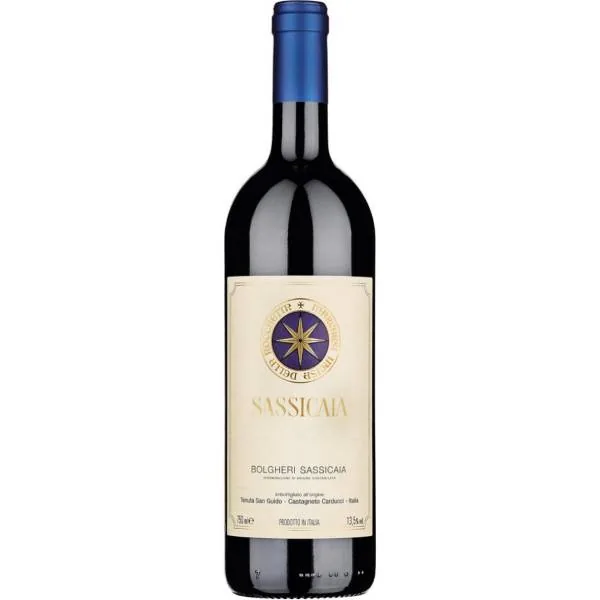
Sassicaia is the wine that created the Super Tuscan category: made from Cabernet Sauvignon (about 85%) and Cabernet Franc grown in Bolgheri, a coastal Tuscan zone with no history of fine winemaking at the time, it broke from the Sangiovese-based DOC/DOCG rules of the region entirely.
Its 1972 vintage placed first among 33 international wines at a blind 1978 Decanter tasting, launching the category's international reputation; in 1994 Sassicaia became the only single-estate wine in Italy to receive its own dedicated DOC. Stylistically it
reads as a Bordeaux blend transplanted to Tuscany: cassis, cedar, graphite and Mediterranean herbs (thyme, rosemary) over finely grained, silky tannin that develops leather and tobacco with age.
Marchese Mario Incisa della Rocchetta planted the original Cabernet Sauvignon cuttings in 1948 on his Tenuta San Guido estate, initially only for family consumption. His son Nicolo and nephew Piero Antinori (of the Antinori wine family) persuaded him to release it commercially, starting with the 1968 vintage, first sold in 1971.
Consulting oenologist Giacomo Tachis later refined the winemaking. The estate also produces two lower tiers from the same vineyards, Guidalberto and Le Difese.
Bistecca alla Fiorentina (grilled T-bone)
The definitive regional pairing: char and fat from the grilled steak meet the wine's tannin and dark-fruit core.
Aged Pecorino with truffle honey
Firm, nutty aged cheese matches the wine's structure without the acidity clash younger cheeses risk.
Neua yang (Thai grilled beef, no chili marinade) (เนื้อย่าง)
Grilled char echoes the wine's cedar notes; needs a mild, non-chili preparation, since capsaicin clashes with tannin.
Product information compiled from producer, importer and reference sources.
Italy's only single-estate DOC: 85% Cab Sauv/15% Cab Franc from calcareous marl and gabbro soils at Bolgheri, 24 months in Tronçais barriques.
When Marchese Mario Incisa della Rocchetta planted Cabernet Sauvignon on the Bolgheri coast in 1944 — two decades before French varieties were fashionable in Tuscany — he produced the wine solely for family consumption until the commercial debut of the 1968 vintage.
That founding decision to harvest just before full phenolic ripeness, preserving fragrance over power, remains the house's defining technical philosophy today.
The estate's plots — Castiglioncello, Aia Nuova, Cerreta, and others — span 100–300 m elevation across soils of calcareous marl, gabbro, alberese, and ancient alluvial pebbles (the 'sassi' that name the wine). The Tyrrhenian Sea moderates summer heat while an
amphitheatre of hills channels cooling sea breezes, producing lower natural alcohol and bracing acidity that separates Sassicaia structurally from riper Bolgheri peers.
Fermentation proceeds in temperature-controlled stainless steel at ≤28–29°C with estate-selected indigenous yeasts; malolactic is spontaneous, also completed in steel. The wine then ages 24 months in French oak barriques (Tronçais, Allier, Jupilles; approximately 40% new, 40% first-fill, 20% second-fill), a regime Mario pioneered in Italy before it became standard practice.
Sassicaia holds the only single-estate DOC in Italy — a classification with no domestic parallel — making it categorically distinct from every other Super Tuscan. The 2020 vintage delivered a warmer growing season, yielding polished tannins and approachable fruit concentration relative to the more austere 2016 and 2019; drink 2025–2038.
** Vintage may change — please confirm with our team.
Sommelier’s pick: Bistecca alla Fiorentina with rosemary-salted crust · Rack of lamb with olive tapenade and roasted garlic jus · Aged Pecorino di Pienza with truffle honey
Loading notes…
Tasted this?
Ask us on LINE.
Ask about this item