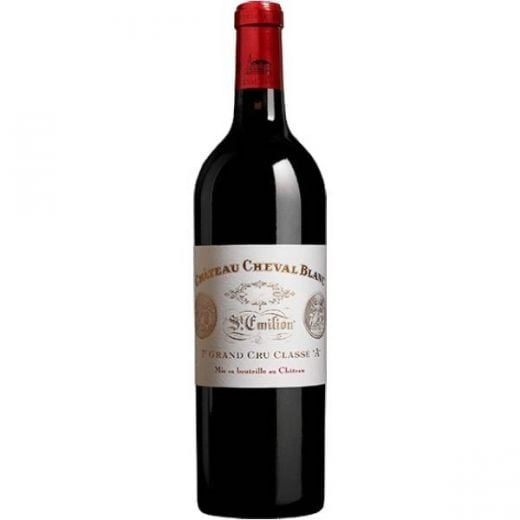
1er Grand Cru Classe A 2015
฿฿฿฿
Rated 100/100 by Wine Enthusiast (top 1% of their reviews).
From our sommelier team
A historic Saint-Émilion estate on the Pomerol border, unusual on the Right Bank for its Cabernet Franc-heavy vineyard (planted roughly 52% Cabernet Franc, 43% Merlot, 5% Cabernet Sauvignon), though the finished blend's actual grape balance shifts by vintage, one of only two Premier Grand Cru Classé A estates named in the original 1955 classification.
Cheval Blanc sits at the edge of Saint-Émilion directly bordering Pomerol, on a distinctive gravelly-clay terroir that historically produces wines of unusual power and perfume for the appellation. Its defining feature is grape composition: where most Right Bank estates lean heavily on Merlot, Cheval Blanc's vineyard is planted with an unusually high share of Cabernet Franc (around 52% to Merlot's 43% and a small share of Cabernet Sauvignon) — though the finished wine's actual blend varies by vintage and is not always Cabernet Franc-majority in the bottle (the 2022, for instance, was Merlot-majority) — giving the wine a more perfumed, structured, and age-worthy profile than a typical Pomerol-style Merlot wine. The estate was one of only two properties (alongside Château Ausone) awarded Premier Grand Cru Classé A status when the Saint-Émilion classification was first published in 1955, a distinction it held through the 2022 vintage before withdrawing from the 2022 reclassification process rather than being reclassified alongside newly promoted estates. Under estate manager Pierre Lurton since the late 1990s, the wine has continued in its historic style: dense fruit, tobacco and graphite complexity, and firm but polished tannins built for long cellaring.
Producer history
The estate was formed in 1832 when Jean-Jacques Ducasse, president of the Libourne Court of Appeals, purchased vineyard parcels split from the neighboring Château Figeac; the property took real shape under his son-in-law Jean Laussac-Fourcaud, and adopted the Cheval Blanc name in 1852. It won recognition at the London and Paris exhibitions of the 1860s and was named Premier Grand Cru Classé A in the inaugural 1955 Saint-Émilion classification, a status it retained for over six decades. In 1998, the château was sold to Bernard Arnault (chairman of LVMH) and Belgian businessman Albert Frère, with Pierre Lurton installed as estate director — a role he has held for over two decades, overseeing continuity of the estate's style through the change in ownership. In early 2022, the estate chose to withdraw from the next Saint-Émilion classification cycle rather than be reclassified.
Signature pairings
- Roast rack of venison with juniper — The wine's Cabernet Franc-driven perfume (tobacco, graphite, dark berry) pairs classically with game meats, where the wine's structure and savory complexity have room to show.
- Aged Comté or Gruyère — A firm, nutty aged cheese matches the wine's own graphite and savory tones without the acid clash that softer, younger cheeses can cause with tannic reds.
In 2015, Technical Director Pierre-Olivier Clouet made a decision that speaks louder than any score: no Petit Cheval was produced — 90.5% of the entire harvest was deemed worthy of the Grand Vin, an extraordinary selection rate that signals the vintage's near-flawless raw material. The Wine Advocate's Lisa Perrotti-Brown awarded 100 points.
The 42-hectare estate sits on quaternary alluvium from the Isle river at Saint-Émilion's north-western edge, directly bordering Pomerol. Soils divide into three identities: gravel over deep blue clay (home to the oldest Cabernet Franc vines, some planted 1920), deep gravel, and sandy clay — non-calcareous throughout, fundamentally unlike the limestone plateau that defines most of Saint-Émilion. That blue clay retains moisture and moderates the estate's slightly warmer, more precocious microclimate, preserving the tension that keeps this wine alive for decades.
The 2015 blend — 55% Merlot, 45% Cabernet Franc — was assembled from up to 56 individually vinified plots, each fermented in a purpose-sized, gravity-filled concrete vat. Malolactic fermentation in tank preceded 16–18 months in 100% new French oak (Tronçais and Bercé forest, 225 L barriques), racked manually 5–7 times under nitrogen. The assembled Grand Vin then returned to barrel for a further ~12 months.
Cheval Blanc remains the only major Right Bank estate where Cabernet Franc — planted here since Jean Laussac-Fourcaud's audacious 1860s replanting — structurally dominates the house identity, even in a Merlot-led vintage like 2015. Drinking window: 2027–2067.
Details
- Country
- France
- Region
- Bordeaux
- Subregion
- Saint-Émilion
- Variety
- Cabernet Sauvignon, Merlot
- Vintage
- 2015
- Bottle size
- 750 ml
Taste profile
- Body
- Full
- Acidity
- Medium-High
- Tannin
- Medium-High
Pairs well with
- Grilled red meat & steak
- Pork dishes
- Cured meats & charcuterie
- Hard & aged cheese
- Game meats
Sommelier’s pick: Roasted Wagyu beef tenderloin with black truffle jus · Slow-braised Ibérico pork cheek with Pedro Ximénez reduction · Roast squab with foie gras and Périgueux sauce
Interested? Talk to us
Message us to check item availability and information.
Community rating
Loading reviews…