 Log in to view
฿฿฿
WNLQ9 vintage signal, averaged from Wine Enthusiast Wine Vintage Chart 2026 Edition's 3 closely-agreeing Tuscany 2019 ratings (Tuscany Bolgheri; Tuscany Chianti Classico; Tuscany Brunello).
A vintage grade rates the growing season in this wine’s region — not this specific bottle. Source.
Researched by our team from producer and independent sources — not supplied by the seller.
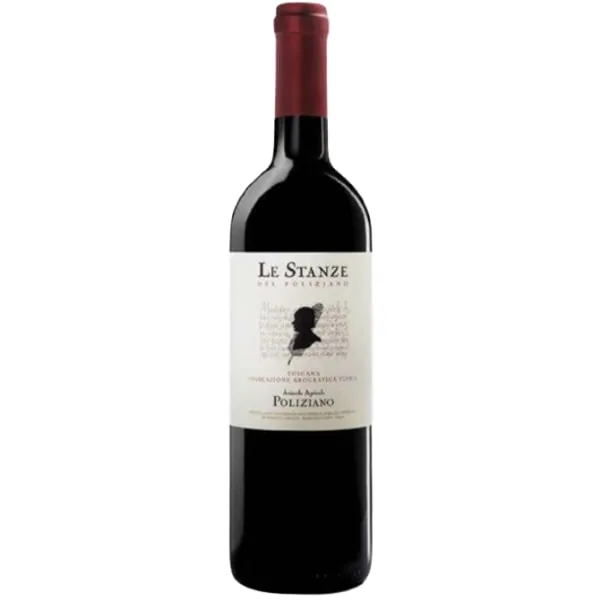
Le Stanze del Poliziano is the Montepulciano estate's single Bordeaux-blend bottling, released as Toscana IGT rather than under the Vino Nobile denomination. The producer describes it as "a classic 'Bordeaux' blend, conceived in Tuscany which appeals also to
international palates, emphasizing the value of the territory of Montepulciano and its potential in the production of great wines for aging," and gives the current composition as "90% Cabernet Sauvignon, with the remainder being Merlot and Petit Verdot."
An importer tech-sheet summary lists an older 80% Cabernet Sauvignon / 20% Merlot formula, so the blend has evidently moved over time and should be treated as vintage-variable. The wine is raised "16 months in new French oak barrels" and runs to "approx. 18.000 bottles" a year.
The style is a dark, structured, oak-framed Cabernet: firm but polished tannin, blackcurrant and graphite depth, and a Tuscan savoury lift underneath.
Poliziano was founded in 1961 when Dino Carletti bought an initial 22 hectares around Montepulciano, driven by what the estate calls "a romantic vision for his native land and its centuries of wine tradition." The name honours Angelo Ambrogini, the fifteenth-century humanist poet from Montepulciano known as Il Poliziano; Le Stanze takes its name from one of his works.
Dino's son Federico Carletti, trained in agriculture, took over management in the late 1970s and remade the business as an estate winery, expanding holdings to 170 hectares across Montepulciano, Montefollonico, Maremma and Cortona. Key expansions followed in Maremma in 1997 and Cortona in 2000, with a temperature- and humidity-controlled ageing cellar built in 2005.
Since 2019 the third generation, Federico's son Francesco Carletti, has acted as an adviser to his father, joined by Maria Stella in 2021. The estate has made certified organic wines from the 2021 harvest onward, after eliminating chemical weeding and insecticides.
Bistecca alla Fiorentina, rare, with olive oil and salt
A char-grilled, rare T-bone is the standing Tuscan partner for a structured Cabernet: the fat and rendered protein soften the tannin while the grill char meets the wine's oak.
Roast rack of lamb with rosemary and garlic
Lamb and Cabernet Sauvignon share a herbal-savoury register, and the meat's fat carries the wine's firm tannin without dulling its dark fruit.
Grilled beef salad with lime, shallot and chilli (ยำเนื้อย่าง)
The grilled beef and herb component suit a Cabernet-led red, but only in a version made mild; the lime acidity and any real chilli heat will sharpen the wine's tannin and strip its fruit, so ask the kitchen to hold the chilli.
Product information compiled from producer, importer and reference sources.
Montepulciano estate wine from clay-limestone slopes; Sangiovese-Canaiolo blend aged in French oak.
Poliziano has farmed the Montepulciano plateau since 1961, working vineyards planted on the region's signature clay-limestone soils at 550–600 meters elevation. The cool nights and southern aspect of these slopes slow ripening, building structure into the fruit.
Le Stanze del Poliziano blends Sangiovese and Canaiolo in proportions that vary by vintage. The wine undergoes fermentation in temperature-controlled stainless steel, then aging in French oak barrels (mix of new and used wood) for approximately 12 months, followed by bottle age before release.
This technique—balancing oak influence with the acidity native to high-altitude Sangiovese—defines the house style.
The I.G.T. classification (rather than the stricter D.O.C.G.) reflects a deliberate choice: Poliziano blends in Canaiolo to soften tannins and add aromatic complexity, a practice that sits outside D.O.C.G. rules. The result is a wine that retains Montepulciano's mineral spine while gaining textural roundness.
Drinking window: 2–8 years from vintage. Current releases show ripe red fruit, dried herb, and subtle oak integration.
Sommelier’s pick: Bistecca alla fiorentina with rosemary and sea salt · Braised wild boar with juniper and red wine reduction · Aged pecorino romano with cured meats
Loading notes…
Tasted this?
Ask us on LINE.
Ask about this item