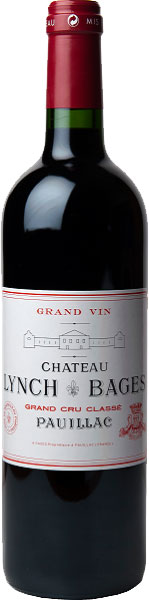
AOC Pauillac 2018
฿฿฿
SaleRated 97/100 by Wine Spectator (top 4% of their reviews).
From our sommelier team
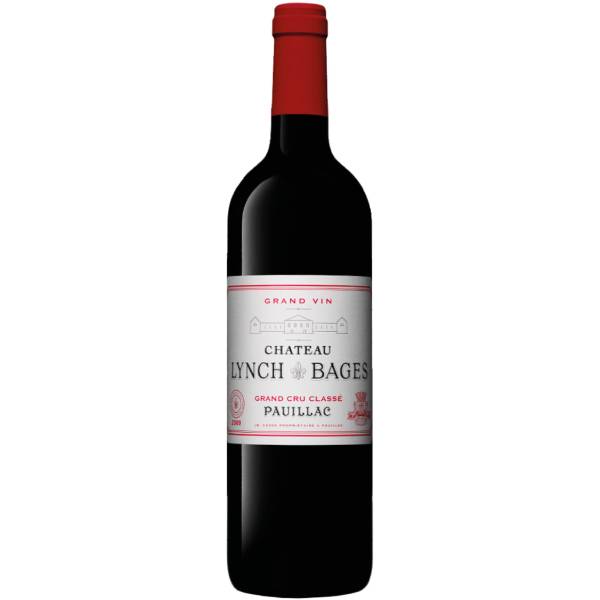
A Cabernet Sauvignon-led fifth-growth Pauillac from the Cazes family, long known for delivering richness and charm well beyond its 1855 classification rank.
Lynch-Bages is a classified fifth growth (Cinquième Cru) from the 1855 Bordeaux classification, but has for decades traded and drunk at a level closer to the second or third growths — a reputation built on consistency rather than any change in official rank. The blend is Cabernet Sauvignon-dominant, typically around 75% Cabernet Sauvignon with Merlot, Cabernet Franc and a small amount of Petit Verdot filling out the remainder, drawn from roughly 100 hectares of gravel, chalk and sand soils on the Bages and Monferan plateaus in Pauillac. The wine is aged in French oak with a high proportion of new barrels (around 70%) for 12-15 months. The house style favors ripe dark fruit (cassis), savory tones of tobacco and wet earth, and firm but well-integrated tannins — powerful without being austere, which is a large part of why it built such a loyal following among drinkers rather than only collectors. A new winery completed in 2021 added extensive stainless steel vats for parcel-by-parcel vinification, reinforcing the estate's ongoing focus on precision winemaking.
Producer history
The vineyard was developed by the Dejean family and sold in 1728 to Pierre Drouillard, whose daughter Elizabeth married Thomas Lynch — an Irish-descended name that stuck to the property (Lynch Bages) even after the family's connection ended, roughly 75 years later. In the 1930s Jean-Charles Cazes began leasing the vines from owner Félix de Vial, buying the estate outright in 1938. His son André Cazes later took over the estate, expanding the vineyard with neighboring parcels (Château Haut-Bages-Avérous, Château Saussus) and replanting land left fallow after phylloxera. Jean-Michel Cazes joined his father in 1973 and led the estate's modern rise in reputation; his son Jean-Charles Cazes took over management in 2007. The property has remained continuously in Cazes family hands since the 1930s, unusual longevity for a Bordeaux classified growth.
Signature pairings
- Grilled ribeye steak — The wine's ripe cassis fruit and firm tannin structure are built for the char and fat of a well-marbled grilled steak, a classic Pauillac pairing.
- Lamb rack with herbs — Cabernet Sauvignon-led Pauillac and lamb is a long-standing regional pairing; the wine's tobacco and earth tones complement herb-crusted lamb without competing.
- Aged Gouda or hard cheddar — A firm-tannin structured red needs a hard, aged cheese with enough fat and savory depth to soften the grip; soft or blue cheeses would clash.
In 1985, a half-bottle of Lynch-Bages 1975 flew aboard NASA's Discovery shuttle — a footnote that captures the estate's outsized ambition relative to its official Fifth Growth rank. That classification, frozen in 1855, has never reflected market reality: Liv-Ex consistently places Lynch-Bages among Bordeaux's Super Seconds, a status earned through Jean-Michel Cazes's 15-year modernisation programme from 1975 and sustained by fourth-generation Jean-Charles Cazes IV since 2006.
The Bages plateau, south-southwest of Pauillac town, sits on deep Garonne gravel over limestone sub-strata — sediment carried by millennia of Pyrenean erosion. Free-draining and heat-retentive, this geology amplifies the 2018 growing season's hot, dry conditions into full phenolic ripeness, producing concentrated blackcurrant and dark berry with cushioned, generous tannins rather than the austere architecture of plateau neighbours Latour or Pichon-Baron.
Vinification proceeds parcel-by-parcel across 80 temperature-controlled stainless-steel vats, with malolactic fermentation split: one-third in vat, two-thirds in barrel. Aging runs 15–18 months in French oak barriques at 75% new oak. Lynch-Bages was the first Bordeaux estate to deploy the Winegrid in-barrel monitoring system (from 2015), tracking alcohol, sugar, colour, and temperature in real time — a precision tool that underpins the house's signature ripe-yet-structured consistency. The 2018 is best approached from 2026, with a long runway beyond.
Details
- Country
- France
- Region
- Bordeaux
- Subregion
- Pauillac
- Variety
- Cabernet Sauvignon, Merlot, Cabernet Franc, Petit Verdot
- Vintage
- 2018 **
- Bottle size
- 750 ml
** Vintage may change — please confirm with our team before ordering.
Taste profile
- Body
- Full
- Acidity
- Medium
- Tannin
- Medium-High
Pairs well with
- Lamb dishes
- Cured meats & charcuterie
- Duck & game birds
- Braised & slow-cooked meat
- Hard & aged cheese
Sommelier’s pick: Roasted rack of lamb with rosemary jus · Dry-aged côte de boeuf with bone marrow butter · Duck confit with black cherry reduction
Interested? Talk to us
Message us to check item availability and information.
Community rating
Loading reviews…