 Log in to view
฿฿
Product information compiled from producer, importer and reference sources.
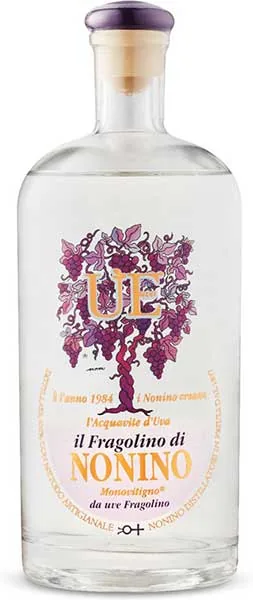
Nonino's 1984 transgression: whole Fragolino grapes — skins, pulp, juice — distilled at the Buttrio Cru into an Acquavite d'Uva that Italian law didn't recognise until Nonino lobbied it into existence.
In 1984, Giannola Nonino and her husband Benito made a deliberate break from grappa orthodoxy: instead of distilling pomace (the pressed, juice-depleted solids), they fermented whole Fragolino grapes — skins, pulp, and juice together — in temperature-controlled stainless-steel tanks under vacuum, then ran the mash through their handcrafted copper steam discontinuous stills in Percoto, Friuli-Venezia Giulia.
The result was a legally undefined spirit; Nonino subsequently lobbied Italian authorities until Acquavite d'Uva (ÙE®) was recognised as its own protected category, rewriting national spirits law.
The Fragolino variety grows at Nonino's 40-hectare Cru vineyard in Buttrio, Friuli — the same plot that supplies Picolit, Ribolla Gialla, and Schioppettino for the house's Monovitigno® range. Fragolino's naturally high aromatic intensity (the variety's name references its wild-strawberry character) is amplified by whole-grape fermentation, which retains volatile esters that pomace distillation cannot access.
Aging follows in small casks drawn from Nonino's seven warehouses — Nevers, Limousin, Grésigne, ex-Sherry, ex-Sauternes, Acacia, wild Cherry, Ash, and Pear wood — with zero color additives. What makes this expression categorically unusual: it occupies the
precise boundary between grappa and Cognac-style eau-de-vie, sharing the terroir specificity of the former and the fruit-forward distillate character of the latter — a position no other Italian producer has replicated at this scale.
Sommelier’s pick: Prosciutto di San Daniele with fresh figs and aged Montasio · Seared foie gras with Sauternes-poached pear · Dark chocolate fondant with raspberry coulis
Loading notes…
Tasted this?
Ask us on LINE.
Ask about this item