 Log in to view
฿฿฿
DOCG, Barolo.
WNLQ9 vintage signal, averaged from Wine Enthusiast Wine Vintage Chart 2026 Edition's 2 closely-agreeing Piedmont 2020 ratings (Piedmont Barbaresco; Piedmont Barolo).
A vintage grade rates the growing season in this wine’s region — not this specific bottle. Source.
Researched by our team from producer and independent sources — not supplied by the seller.
The Ceretto story begins in the 1930s with Riccardo Ceretto, originally from Valdivilla di Santo Stefano Belbo, who founded the winery in Alba on Corso Langhe. His sons Bruno and Marcello changed the company's direction from the 1960s by selecting and buying vineyards in some of the most prestigious parts of Langhe and Roero, including key Barolo and Barbaresco crus.
In that period the family acquired its first vineyard in Asili at Barbaresco and established the Bricco Asili winery, founded I Vignaioli di Santo Stefano for Moscato d'Asti in 1976, became owners of the Brunate and Prapo crus, and began building the Bricco Rocche winery at Castiglione Falletto.
Bricco Rocche Barolo debuted in the 1980s and Blange followed in 1985, after which the company moved its headquarters to Tenuta Monsordo Bernardina. The third generation, Alessandro, Federico, Lisa and Roberta, brought a new direction, including the restoration of the Cappella del Barolo in the Brunate vineyard at La Morra with the artists David Tremlett and Sol LeWitt.
The family now farms around 180 hectares across Langhe and Roero and achieved organic certification in 2015.
Brasato al Barolo with polenta
The long-braised beef dissolves into gelatine that coats the palate and blunts Nebbiolo's considerable tannin, while the wine's acidity keeps a rich, starchy plate from turning heavy.
Thai braised pork belly in five-spice and soy (หมูพะโล้)
A chilli-free Thai braise is the safe bridge to a tannic Barolo: star anise and cinnamon echo Nebbiolo's tar-and-spice register, and the fatty pork plus soy salt soften the tannin the way an Italian braise would.
Aged Castelmagno with hazelnuts
The Piedmontese regional match: a crumbly, pungent aged cow's cheese has enough salt and fat to take the tannin, and local hazelnut picks up the nutty notes that develop in mature Nebbiolo.
Product information compiled from producer, importer and reference sources.
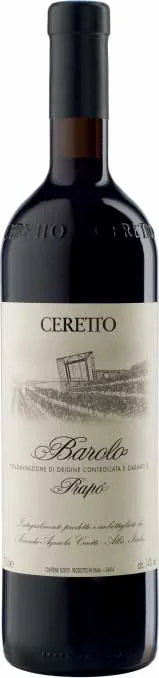
Barolo from Ceretto's organic Prapo vineyard: Nebbiolo aged in large oak, structured for 15+ years.
Ceretto's organic turn in Barolo began in earnest in the 1990s, with Prapo representing the producer's commitment to biodynamic viticulture in one of Piedmont's most demanding terroirs. The vineyard sits on the south-facing slopes of Serralunga d'Alba, where calcareous marl and limestone soils at 280–320 meters elevation create the mineral backbone characteristic of this cru.
Nebbiolo from Prapo undergoes extended maceration in temperature-controlled conditions, then ages in large Slavonian oak casks (40+ hectoliter capacity) for 24+ months, avoiding the new-oak overlay that defines many modern Barolos. This vessel choice preserves the wine's tannin structure while allowing slow oxidative development.
The organic farming protocol—no synthetic inputs, cover crops between rows—intensifies phenolic ripeness without chemical intervention.
Prapo stands apart within Ceretto's range for its restraint and mineral persistence; where other Barolo cuvées court immediate richness, this expression prioritizes transparency to soil and vintage character. The 2019 and 2020 vintages show the wine's capacity to age gracefully, with tannins that soften into silky texture after 5–8 years in bottle.
** Vintage may change — please confirm with our team.
Sommelier’s pick: Brasato al Barolo (beef braised in Barolo reduction) · Tajarin with wild boar ragù · Roasted lamb with rosemary and garlic
Loading notes…
Tasted this?
Ask us on LINE.
Ask about this item