 Log in to view
฿฿฿฿
Rated 98/100 by Wine Spectator (top 1% of their reviews).
Researched by our team from producer and independent sources — not supplied by the seller.
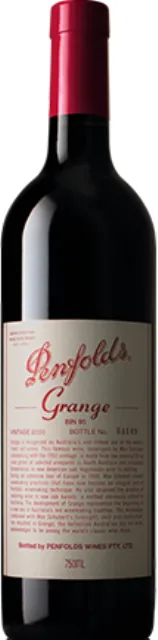
Australia's most famous wine — a Shiraz-led icon built on Max Schubert's postwar Bordeaux-inspired experiment, dense and powerful.
Grange (originally 'Grange Hermitage') was developed by Penfolds chief winemaker Max Schubert after a 1950 study trip to Bordeaux, where he set out to build an Australian wine capable of aging at least twenty years using Shiraz instead of Cabernet. It is
predominantly Shiraz, typically with a small amount of Cabernet Sauvignon, sourced from multiple South Australian regions (Barossa Valley, McLaren Vale, Magill) rather than a single vineyard, using partial barrel fermentation and 18-20 months of new American oak maturation.
The style is dense and powerful: intensely rich dark fruit, chocolate, coffee and oak spice over ripe tannins and full body, built to soften and gain complexity over decades of cellaring.
Penfolds was founded in 1844 in Adelaide by English physician Christopher Rawson Penfold and his wife Mary, initially making fortified wines prescribed as tonics. Mary Penfold personally oversaw blending in the winery's early decades. Max Schubert made the
first experimental Grange in 1951; when management rejected the wine in 1957, he secretly continued crafting vintages at the Magill cellars through 1959 rather than abandon the project, a decision credited with saving what became Australia's most celebrated red.
Peter Gago has been chief winemaker since 2002.
Charcoal-grilled wagyu or ribeye
Full body and firm tannin need richly marbled, charred beef to soften the wine's density and structure.
Braised beef cheek or short rib
Slow-braised, gelatinous beef matches the wine's power and dark fruit better than a leaner preparation would.
Aged cheddar or gouda
Firm, sharp aged cheese stands up to the wine's oak and tannin without being overwhelmed by its power.
Product information compiled from producer, importer and reference sources.
Multi-district Shiraz fermented and finished in 100% new American oak hogsheads — the deliberate anti-terroir that cellars 40–50+ years.
In 1951, Max Schubert returned from Bordeaux determined to build Australia's first age-worthy red — not from a single château plot, but by blending the top fruit across South Australia's districts and completing fermentation inside new American oak hogsheads, a technique he borrowed from the Médoc and made entirely his own.
That founding transgression remains the technical core of every Grange made since.
The 2020 blend draws predominantly from Barossa Valley (typically 77–82% of the final wine), where ancient, deep alluvial and sandy loam soils — phylloxera-free since settlement — force Shiraz vines into low-yield concentration. McLaren Vale's
sea-breeze-moderated Mediterranean warmth and Magill Estate's urban hillside block at the foot of the Mount Lofty Ranges contribute structural counterpoint in select proportions.
Fermentation proceeds in small open-top stainless steel fermenters, with the final stages completed inside the aging vessel itself — 100% new American oak hogsheads (slightly larger than Bordeaux barriques), where the wine then matures for 18–20 months. Acclimatised pure yeast cultures and temperature-controlled fermentation, a Penfolds innovation pioneered by Ray Beckwith, underpin vintage-to-vintage consistency.
The blend is typically 93–98% Shiraz with 2–7% Cabernet Sauvignon, sealed under natural cork at approximately 14.5% ABV.
No other commercially produced wine in the New World is heritage-listed by a national trust — Grange holds that status in South Australia — and no peer has matched its documented 40–50+ year cellaring trajectory outside Bordeaux's First Growths.
** Vintage may change — please confirm with our team.
Sommelier’s pick: Dry-aged Wagyu ribeye with bone marrow butter · Slow-braised Barossa Valley lamb shoulder with anchovy and rosemary · Venison loin with juniper jus and celeriac purée
Loading notes…
Tasted this?
Ask us on LINE.
Ask about this item