 Log in to view
฿฿฿฿
Rated 95/100 by Wine Spectator (top 14% of their reviews).
WNLQ9 vintage signal, averaged from Wine Enthusiast Wine Vintage Chart 2026 Edition's 3 closely-agreeing Tuscany 2019 ratings (Tuscany Bolgheri; Tuscany Chianti Classico; Tuscany Brunello).
A vintage grade rates the growing season in this wine’s region — not this specific bottle. Source.
Researched by our team from producer and independent sources — not supplied by the seller.
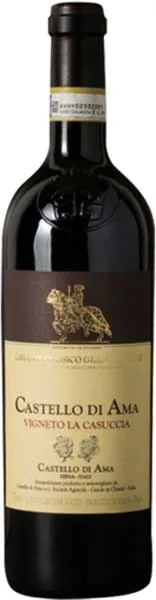
Vigneto La Casuccia is a single-vineyard Chianti Classico Gran Selezione DOCG from Castello di Ama at Gaiole in Chianti, made in exceedingly limited quantities and only in the best vintages rather than every year. Its first release was 1985. The estate's
technical sheet for the 2018 describes a vineyard of 12.58 hectares, six of them planted in 1978 and the remainder in 2007, terraced to improve aspect and even out ripening, and divided into nine parcels, of which numbers 49, 46 and 45 typically supply this selection in the strongest vintages.
That sheet gives an altitude of 470 to 495 metres, clay and calcareous soil, a north-east to south-west exposure, vine density from 5,200 per hectare, and training split between single Guyot and open Lyra. Unusually for Chianti Classico, the blend includes a substantial Merlot component alongside Sangiovese: the 2018 was 80 per cent Sangiovese and 20 per cent Merlot at 13.5 per cent alcohol.
The two varieties are fermented separately with ambient yeasts in steel at 30 to 33 degrees, with manual pump-overs and a total cuvaison of 27 days for the Sangiovese and 25 for the Merlot. After the first racking the wine goes to barrique for malolactic
fermentation, the varieties are blended once that finishes, and it then matures around 14 months in fine-grain oak barriques, 40 per cent new and the rest one year old.
Castello di Ama sits at Ama, in the commune of Gaiole in Chianti, within the Chianti Classico zone at around 430 to 520 metres above sea level. The company was founded in 1976 by four Rome-based families to restore a Chianti Classico estate of 55 hectares. From 1978 the owners began identifying individual parcels for their soils and microclimates, and the first vintage of Vigneto Bellavista was made that year.
Marco Pallanti, then a young agronomist, joined as winemaker in 1982, the same year associated with Vigneto San Lorenzo; Vigneto La Casuccia followed in 1985 and Vigneto Bertinga in 1988. Lorenza Sebasti, the daughter of one of the founding partners, joined in 1988 and became chief executive.
Pallanti serves as general manager and oenologist, and was President of the Chianti Classico Consortium from 2006 to 2012, during which he helped create the Gran Selezione category under which this wine is now classified. The estate today farms around 75 hectares of vineyard and 40 hectares of olive groves, employs more than 60 people and produces about 320,000 bottles a year.
Peposo, Tuscan beef stew with black pepper and red wine
A long-braised beef dish gives the collagen and fat that soften firm Sangiovese tannins, and the coarse black pepper picks up the savoury, tobacco-edged side the wine develops with age.
Massaman beef curry with potato and peanut (แกงมัสมั่นเนื้อ)
Massaman is the mildest of the Thai curries, built on cinnamon, cardamom and tamarind rather than chilli heat. Its richness meets the fuller, Merlot-softened mid-palate of this blend, and the warm spices run with the oak-derived spice from barrique ageing.
Duck breast with sour cherry sauce
Sour cherry mirrors the dominant fruit character of Sangiovese directly, and duck has enough fat to carry the tannins while staying lighter than beef, which suits the wine's elegance rather than overwhelming it.
Product information compiled from producer, importer and reference sources.
Sangiovese-Merlot blend from Chianti's Vigneto La Casuccia: elegant red fruit, herbaceous spice, and mineral complexity.
Castello Di Ama's Vigneto La Casuccia is a Super Tuscan expression of Chianti terroir, blending 80% Sangiovese with 20% Merlot to create a wine of medium-full body and refined structure. The 2019 vintage reveals primary notes of red cherry and plum, supported by herbaceous and spice-driven secondary characteristics.
Tertiary layers of earth, tobacco, and minerality emerge with air, reflecting the wine's age-worthiness and complexity. A food-friendly Tuscan red suited to grilled meats, tomato-based pasta, and aged cheeses.
** Vintage may change — please confirm with our team.
Loading notes…
Tasted this?
Ask us on LINE.
Ask about this item