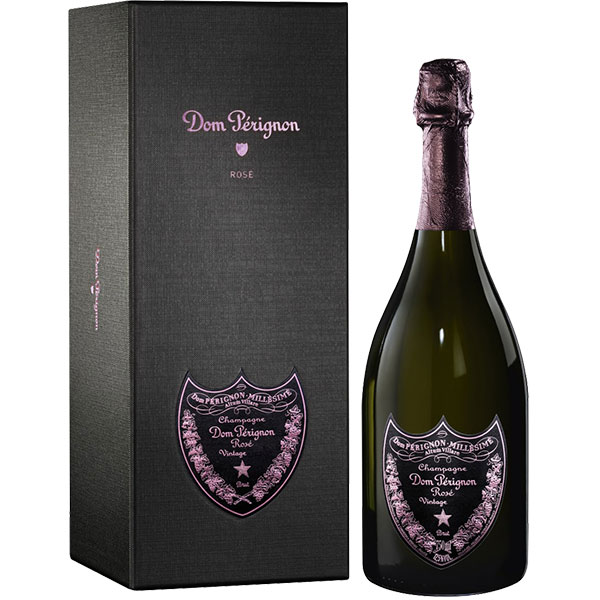
Rose Vintage with Gift Box
฿฿฿฿
Rated 96/100 by Wine Spectator (top 8% of their reviews).
From our sommelier team
A vintage rosé Champagne blending roughly 56% Pinot Noir and 44% Chardonnay, showing ripe red fruit (raspberry, cherry, blood orange), floral and toasted-brioche notes, with a powerful, structured palate and long finish characteristic of Dom Pérignon's house style.
Dom Pérignon Rosé is produced by blending in a separately vinified still red Pinot Noir wine — sourced from black-skinned Pinot Noir macerated on the skins for a short period (roughly 3-4 days) and picked at lower potential alcohol — into the base cuvée, with the red-wine portion having made up as much as a quarter or more of the total Pinot Noir in some vintages (e.g. around 27% of the 55% Pinot Noir in the 2005). This is the same still-red-wine blending method used by many rosé Champagnes, not an alternative to it; the house frames the goal as creating tension between the red-wine character of the Pinot Noir and Dom Pérignon's classic white-wine identity. [CORRECTED: the original text claimed DP Rosé is made via skin-contact/saignée vinification and does NOT blend in still red wine — this was factually backwards. Verified via https://www.the-buyer.net/tasting/wine/dom-perignon-rose-2005-launch, which documents the still-red-wine blending method explicitly.]
Producer history
Dom Pérignon takes its name from Dom Pierre Pérignon (1638-1715), a Benedictine monk who served as cellar master of the Abbey of Hautvillers near Épernay from 1668 until his death, and who is credited with major advances in winemaking and blending in the Champagne region during his lifetime, though the popular legend that he "invented" sparkling champagne is not historically accurate. In 1823 the Hautvillers abbey estate was purchased by Pierre-Gabriel Chandon (son-in-law of Jean-Rémy Moët) and its vineyards restored; in 1937 Moët & Chandon acquired the Dom Pérignon name and later launched it as the house's prestige cuvée, a line it continues to produce today.
Signature pairings
- Roasted duck breast with cherry reduction — The wine's red-fruit character and structured palate mirror the richness of duck and a fruit-based sauce.
- Sushi with toro (fatty tuna) (とろ) — High acidity and fine mousse cut through the fattiness of toro while the wine's depth matches the richness of the fish.
- Wild strawberry and rose petal dessert — The wine's own red berry and floral notes echo a light fruit-forward dessert without competing with heavy sweetness.
Dom Pérignon has never produced a non-vintage wine in its entire history — every bottle carries a year, and if that year falls short, nothing is released. That absolute standard is the founding logic of the world's first prestige cuvée, commercially launched in 1936 and named for Dom Pierre Pérignon, Benedictine cellarmaster at Abbaye d'Hautvillers from 1668. The Rosé Vintage draws Pinot Noir from Aÿ, Bouzy, Mailly-Champagne, and Verzenay, and Chardonnay from Chouilly, Cramant, Avize, and Le Mesnil-sur-Oger — all Grand or Premier Cru — rooted in deep chalk and limestone that functions as a moisture reservoir, sustaining vine hydration through stress periods and driving the house's signature mineral tension. Vinification is entirely in stainless steel, with malolactic fermentation conducted and oxygen contact minimised at every stage — a reductive philosophy that suppresses oxidative development and locks in the smoky, chalk-driven aromatic profile. Chef de Cave Vincent Chaperon deploys two distinct yeast strains for primary fermentation and two further strains for the in-bottle prise de mousse, treating yeast selection as the primary lever for long-term ageing capacity. No oak is used at any point. The Plénitude system — releasing the same undisgorged vintage at three separate maturation windows (P1 ~8–9 yrs, P2 ~15 yrs, P3 ~30–40 yrs) — has no true parallel among grandes marques. Dosage sits at approximately 4.5–5 g/L, preserving the site's natural acidity rather than masking it.
Details
- Country
- France
- Region
- Champagne
- Variety
- Chardonnay, Pinot Noir, Pinot Meunier
- Vintage
- 2009 **
- Bottle size
- 750 ml
** Vintage may change — please confirm with our team before ordering.
Taste profile
- Body
- Medium-Full
- Acidity
- High
- Sweetness
- Dry
Pairs well with
- Shellfish & crustaceans
- Duck & game birds
- Grilled & roasted fish
- Hard & aged cheese
- Fruit desserts & tarts
Sommelier’s pick: Grilled langoustine with bisque butter and tarragon · Duck breast à l'orange with wild cherry jus · Tuna tataki with yuzu kosho and micro shiso
Interested? Talk to us
Message us to check item availability and information.
Community rating
Loading reviews…