 Log in to view
฿฿฿
WNLQ9 vintage signal, averaged from Wine Enthusiast Wine Vintage Chart 2026 Edition's 3 closely-agreeing Bordeaux 2021 ratings (Bordeaux Pomerol/Saint-Emilion; Bordeaux Medoc; Bordeaux Graves Red).
A vintage grade rates the growing season in this wine’s region — not this specific bottle. Source.
Researched by our team from producer and independent sources — not supplied by the seller.
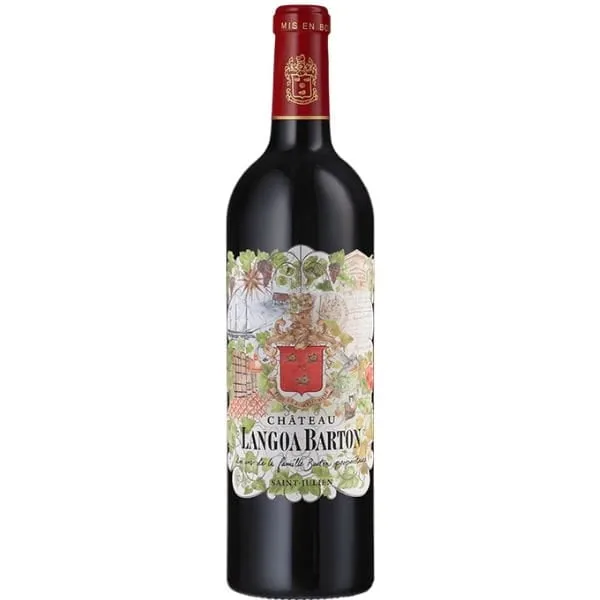
Château Langoa Barton is a Saint-Julien estate classified a Third Growth in the 1855 classification, and it has belonged to the Barton family since 1821. The property covers 20 hectares planted on gravelly soils over a clay subsoil — an outcrop of Quaternary gravel the estate credits with bringing each vintage to full maturity.
The plots overlook the river, and the estate links that proximity, and the milder temperatures that come with it, to early ripening. Plantings are 54% Cabernet Sauvignon, 35% Merlot and 11% Cabernet Franc, with vines averaging 37 years old. In the cellar the
fruit is de-stemmed and passed over a vibrating table and then an optical sorter before going into temperature-controlled wooden vats housed in a gravity vat-house built in 2021.
Fermentation generally runs a few days, with the juice pumped over the cap twice daily to draw out colour, tannin and aroma. After maceration the wine goes to French oak barrels for 18 months, 60% of them new and bought from several coopers, with the barrels kept topped up and racked every three months by the candle method.
Fining is done with egg whites — three to six per barrel, separated by hand — fourteen months into ageing, followed by a racking 45 days later. Blending is normally finished by the end of January, with consultant oenologist Eric Boissenot tasting alongside the family and technical director, and bottling happens at the château in June.
The Barton story in Bordeaux begins in 1722, when Thomas Barton, aged 27, was sent to France — first Montpellier, then Marseille. He reached Bordeaux in 1725 and set up his first wine merchant company. By 1737 he had made a small fortune and locals had nicknamed him "French Tom"; in 1743 he brought his only son William into the business, and he died in 1780 aged 85.
Hugh Barton began as a wine merchant in 1786 and lived through the Revolution: he and Anna were arrested on 14 October 1793 and freed that December, while William died on 23 October. Hugh bought Château Langoa — previously known as Pontet-Langlois — in 1821, and in 1826 acquired a plot from the Léoville domaine, renaming it Léoville Barton.
The 1855 classification listed Langoa Barton a Third Growth. Ronald Barton, born in London in 1902, arrived in Bordeaux in 1924, left in June 1940 to join the Royal Inniskilling Fusiliers, and returned in 1945 to restore the vineyards. Anthony Barton moved to Bordeaux in 1951 and took over the estates from Ronald in 1983; Ronald died in 1986 and Anthony in January 2022.
Lilian Barton Sartorius joined her father's merchant company in 1978 and now runs the wine properties; the family added Château Mauvesin Barton in 2011.
Roast rack of lamb with thyme and white beans
Lamb is the classic Médoc match: its sweet fat meets Cabernet tannin without needing a heavy sauce, and the herb and bean notes track the savoury, cedary side of a mature Saint-Julien.
Grilled pork neck with roasted-rice dipping sauce (คอหมูย่างน้ำจิ้มแจ่ว)
The charred, fatty pork gives the wine something to cut through, and the roasted-rice powder in the jaew brings a toasty note that meets the barrel ageing. Ask for the chilli kept moderate: real heat flattens fine Cabernet tannin and makes it taste harder.
Mushroom and chicken-liver toast
Earthy mushroom and the iron edge of liver pick up the savoury register a mid-weight Saint-Julien develops with age, and the toast supplies the texture to carry the wine's tannin at the start of a meal.
Product information compiled from producer, importer and reference sources.
A refined and structured Saint-Julien with cassis, cedar, and graphite—elegant, classic, and built for aging with remarkable balance.
Château Langoa Barton is one of the most respected estates in Saint-Julien, owned by the Barton family since the 18th century—one of the few Bordeaux châteaux still in the hands of its founding lineage.
Classified as a Third Growth (3ème Grand Cru Classé) in 1855, Langoa Barton consistently delivers wines that reflect the essence of traditional Bordeaux: structure, restraint, and long-term aging potential.
Located on gravel-rich soils in Saint-Julien—one of Bordeaux’s most balanced appellations—the estate produces wines that sit beautifully between the power of Pauillac and the finesse of Margaux. The winemaking philosophy remains classic, focusing on purity of fruit, moderate oak, and longevity rather than excessive extraction.
The result is a wine that evolves gracefully over time—transforming from firm and structured in youth into something deeply complex and harmonious with age.
** Vintage may change — please confirm with our team.
Loading notes…
Tasted this?
Ask us on LINE.
Ask about this item