 Log in to view
฿฿฿฿
Rated 98/100 by Wine Advocate (top 4% of their reviews).
Researched by our team from producer and independent sources — not supplied by the seller.
Coleraine was first released in 1982 as a single-vineyard wine from a different Te Mata parcel, only becoming a multi-parcel blend drawing on the historic Havelock Hills vineyard (first planted in 1892) from the 1989 vintage onward — a change in sourcing worth knowing, since the wine's early vintages and its current identity are not quite the same wine in that specific sense.
Te Mata's vineyard history dates to 1892, when Bernard Chambers — son of Te Mata Station's founder John Chambers — returned from studying winemaking in France and planted vines on the north-facing Havelock Hills, converting the estate's stables into a winery by 1896.
The Chambers family sold the property in 1919, and after passing through other owners it was acquired by the Buck and Morris families in 1974, who rebuilt it into the estate known today. Coleraine, first made in 1982, became the winery's flagship wine.
Herb-crusted roast lamb
The wine's fine tannins and cassis-cedar depth complement roast lamb's richness and herbal crust, a pairing frequently cited by the producer and reviewers.
Grilled venison with juniper jus
Dark fruit and cedar notes in the wine mirror the gaminess and savory depth of venison.
Aged cheddar
Firm tannins and moderate alcohol pair well with the salty, dense richness of a well-aged hard cheese.
Product information compiled from producer, importer and reference sources.
Bridge Pa Bordeaux blend from New Zealand's most awarded estate—18 months in French oak, structured for two decades.
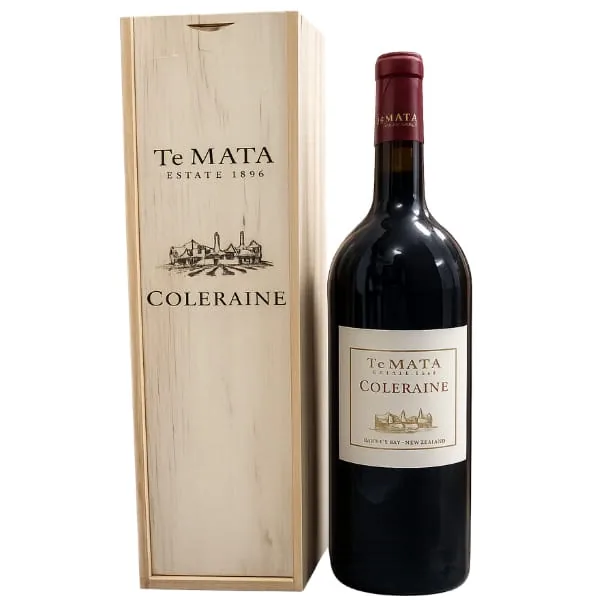
Te Mata's Coleraine represents the flagship red from Hawke's Bay's most decorated producer, established 1896. The vineyard sits in Bridge Pa, a subregion defined by free-draining alluvial gravels over clay, with north-facing aspect and afternoon nor'west winds that moderate ripening and preserve acidity.
The blend—primarily Cabernet Sauvignon with Merlot and Cabernet Franc—ferments in temperature-controlled stainless steel before 18 months in French oak (predominantly new and one-year-old barrels). Malolactic conversion occurs in barrel, integrating oak tannins with fruit structure. The wine is neither fined nor filtered before bottling.
Coleraine's distinction lies in its longevity architecture: this is a wine built for cellaring, with tannin integration that demands 5–10 years minimum before approachability. Recent vintages show the estate's shift toward fresher, more transparent fruit expression while maintaining power.
Current release shows dark berry density, graphite minerality from Bridge Pa gravels, and oak integration that frames rather than dominates. Drinking window: 2026–2050.
Sommelier’s pick: Dry-aged ribeye with rosemary jus · Braised beef short ribs with red wine reduction · Lamb shoulder with thyme and garlic
Loading notes…
Tasted this?
Ask us on LINE.
Ask about this item