 Log in to view
฿฿฿
WNLQ9 vintage signal, averaged from Wine Enthusiast Wine Vintage Chart 2026 Edition's 3 closely-agreeing Tuscany 2019 ratings (Tuscany Bolgheri; Tuscany Chianti Classico; Tuscany Brunello).
A vintage grade rates the growing season in this wine’s region — not this specific bottle. Source.
Researched by our team from producer and independent sources — not supplied by the seller.
Old-vine Sangiovese from high-altitude, stony galestro-soil parcels around Fiesole and other Tuscan hill sites, hand-worked and fermented with indigenous yeasts for a wine that emphasizes purity, minerality, and transparency of fruit over power.
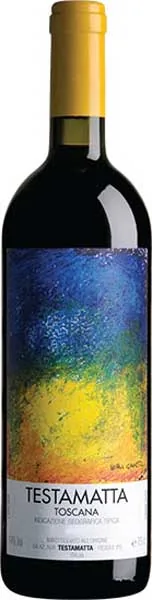
Testamatta is essentially 100% Sangiovese but deliberately released as Toscana IGT rather than any DOCG designation, since Bibi Graetz sources fruit from multiple non-contiguous old-vine parcels (historically including sites around Fiesole and Vincigliata) rather than a single appellation-bound vineyard — a stylistic choice, not a quality shortfall; the 2006 vintage scored 98 points from Wine Spectator.
Bibi Graetz, trained as a painter at the Accademia delle Belle Arti di Firenze, took over his family's old vineyards in the hills around Fiesole in the late 1990s after training with winemaker Alberto Antonini. The winery is based in the former Hotel Aurora building on Fiesole's main square, where Graetz still lives, and the first Testamatta vintage was released in 2000, quickly drawing critical attention.
Wild boar ragu with pappardelle (pappardelle al cinghiale)
Sangiovese's bright acidity and earthy tannin cut through the richness of a slow-cooked game ragu, a classic Tuscan pairing logic.
Bistecca alla Fiorentina
The wine's Tuscan hill-country origin and firm acid structure mirror the traditional regional pairing with grilled T-bone steak.
Product information compiled from producer, importer and reference sources.
Self-taught artist, 100% Sangiovese from north-facing galestro slopes — Burgundian transparency over Tuscan muscle, unfiltered, ~10% new oak.
Bibi Graetz arrived at winemaking in 2000 with no formal oenology training, a 2-hectare family plot at Castello di Vincigliata in the Fiesole hills northeast of Florence, and a deliberate refusal to pursue the Super Tuscan power template. That founding
instinct has since been codified into a sourcing rule: Testamatta draws exclusively from north-facing or cooler-mesoclimate sites — Vincigliata, Olmo, Londa, Lamole, and Montefili — where stony galestro (schist) and clay soils at high-altitude hillside elevations restrict vigour, sharpen acidity, and drive mineral precision over fruit weight.
The 100% Sangiovese blend, from vines 35–50 years old, undergoes spontaneous fermentation on indigenous yeasts in open-top 225L French oak barriques with manual pigeage and zero concentration techniques. Aging runs 20 months in French oak, approximately 10% new, 75% second-to-fourth-fill, followed by a minimum 6 months in bottle before release; the wine is bottled unfiltered.
The rule broken here is categorical: despite sourcing from Chianti Classico DOCG sites including Lamole and Montefili, Graetz deliberately declassifies every bottle to Toscana IGT, rejecting the appellation hierarchy entirely. The 2019 vintage delivers the
fresh, precise character the north-facing parcel strategy is designed to produce — taut galestro-driven structure with the lifted acidity that rewards 3–8 years of further cellaring.
** Vintage may change — please confirm with our team.
Sommelier’s pick: Bistecca alla Fiorentina with rosemary-salted crust · Aged Pecorino di Pienza with truffle honey · Grilled lamb chops with salsa verde
Loading notes…
Tasted this?
Ask us on LINE.
Ask about this item