 Log in to view
฿฿฿฿
Rated 98/100 by Wine Enthusiast (top 3% of their reviews).
Wine Enthusiast Wine Vintage Chart 2026 Edition rates Champagne 2016.
A vintage grade rates the growing season in this wine’s region — not this specific bottle. Source.
Researched by our team from producer and independent sources — not supplied by the seller.
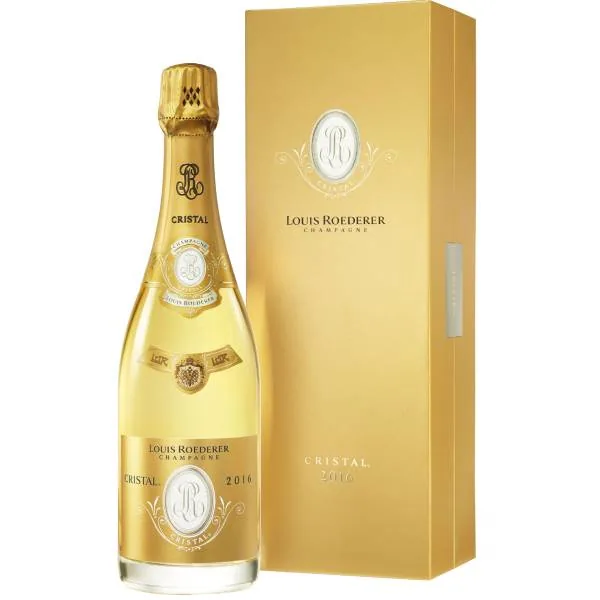
Champagne's original prestige cuvee, created in 1876 for Tsar Alexander II — its clear crystal bottle was his own request.
Cristal was created in 1876 for Tsar Alexander II of Russia, Louis Roederer's most important customer at the time. The Tsar wanted a bottle that would let him see the wine's color and effervescence, which standard dark glass concealed -- so Roederer commissioned a clear, flat-bottomed crystal bottle, a design largely unchanged today and considered the origin of the modern 'prestige cuvee' category.
The wine comes entirely from up to 45 estate-owned, biodynamically farmed plots, blended roughly 60% Pinot Noir to 40% Chardonnay, aged about six years in the house's cellars. Vintages run precise and linear, built on bright acidity and chalky mineral notes, with dark cherry, citrus and almond character that shifts somewhat year to year.
The house began as Dubois Pere & Fils in 1776 and was inherited and renamed by Louis Roederer in 1833. Roederer aggressively pursued the Russian imperial market, and Tsar Nicholas II later named the house official supplier to the Russian court -- the relationship that led to Cristal's creation for Alexander II.
The distinctive clear crystal bottle, patented in the 19th century, remains the cuvee's signature detail to this day.
Caviar with creme fraiche
A historic pairing befitting the wine's imperial origin: fine bubbles and acidity cut the caviar's salinity and richness.
Lobster with drawn butter
Rich, sweet shellfish matches the wine's depth from extended aging while the acidity keeps the pairing from feeling heavy.
Grilled Thai prawns with lime and garlic (light chili) (กุ้งเผา)
Sweet grilled shellfish and citrus echo the wine's own brioche-and-citrus profile, but heavy chili would overwhelm its precision.
Product information compiled from producer, importer and reference sources.
In 1876, Louis Roederer created Cristal exclusively for Tsar Alexander II — bottled in flat-bottomed clear crystal glass so the Tsar's guards could inspect for concealed explosives. That same bottle architecture survives today, now wrapped in UV-protective yellow cellophane to shield the wine aging within.
The 2016 Cristal is assembled from 45 discrete Grand Cru plots across seven communes — Verzenay, Verzy, Beaumont-sur-Vesle, Aÿ, Avize, Mesnil-sur-Oger, and Cramant — totalling roughly 80 hectares farmed fully biodynamic since 2012, the largest certified biodynamic estate in Champagne.
Soils are predominantly pure chalk beneath a thin clay-loam topsoil of approximately 20 cm; mid-slope drainage concentrates mineral tension and restrains vine vigour. Chef de Cave Jean-Baptiste Lécaillon vinifies each parcel separately in small stainless-steel tanks or oak vats, then blends ~60% Pinot Noir with ~40% Chardonnay — no reserve wines incorporated, preserving the singular character of a single harvest.
A portion of the blend undergoes blocked malolactic fermentation to sustain structural acidity. The wine rests 6 years on lees followed by 8 months post-disgorgement before release, with dosage of ~7–8 g/L. Unlike any peer prestige cuvée, Cristal draws 100% of its fruit from Roederer's own estate — zero purchased fruit — giving it grower-Champagne precision at maison scale. Drink from 2026 through the mid-2030s.
** Vintage may change — please confirm with our team.
Sommelier’s pick: Hokkaido sea urchin with yuzu beurre blanc · Grilled Dover sole with brown butter and capers · Aged Comté with honeycomb
Loading notes…
Tasted this?
Ask us on LINE.
Ask about this item