 Log in to view
฿฿฿
Rated 97/100 by Wine Enthusiast (top 6% of their reviews).
Researched by our team from producer and independent sources — not supplied by the seller.
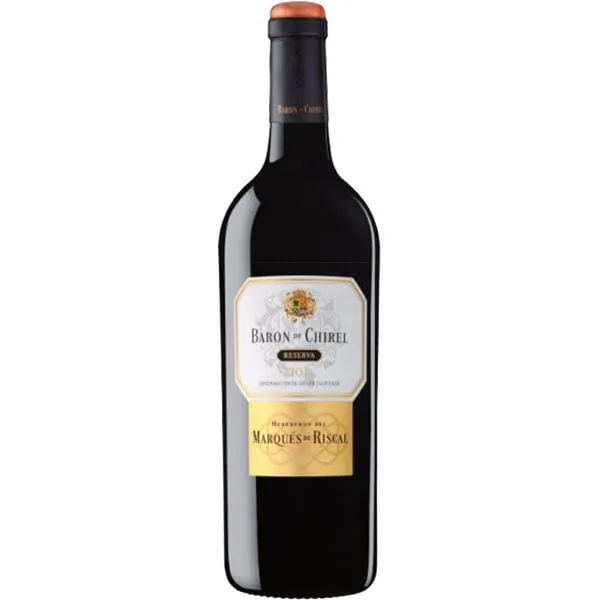
Barón de Chirel is a red of Marqués de Riscal, bottled under D.O.Ca. Rioja and first made in 1986 as a response to growing interest in fine-quality Rioja. The estate frames it as an experimental wine meant to revive the grandeur of the historic Médoc-styled Riojas, blends that had combined Tempranillo with Cabernet Sauvignon in the best years only.
The label declares Tempranillo plus other varieties without publishing percentages. Fruit comes from the area of Elciego in Rioja Alavesa, specifically the plots of Garcimoracho, Tapias, San Pelayo, Vialba and La Collada, at 450 to 550 metres above sea level on chalky clay and gravelly Ebro terraces over limestone bedrock.
The wine is built on old vines: plantings between roughly 80 and 110 years of age were selected for very low yields, and declared yields run 2,500 to 3,500 kg per hectare. Grapes are picked by hand into 15 kg crates and sorted berry by berry on tables, a practice in place since 1995.
Alcoholic fermentation takes place in French Allier oak vats at 26°C with each plot fermented separately and referenced to its origin; malolactic fermentation also happens in fine-grained Allier oak. The wine then goes to French Allier oak barrels for 16 to 17 months depending on vintage, and once bottled rests a minimum of twenty further months before release.
Recent vintages have been declared at 15.2 to 15.5% alcohol.
Marqués de Riscal is based at C/Torrea 1 in Elciego, Álava, in the heart of Rioja Alavesa, with its headquarters in a building dating from 1858 designed by the architect Ricardo Bellsola. The winery's history is bound up with Bordeaux from the start: its original bodega, begun in 1860, was shaped by the know-how of cellar master Jean Pineau, who came from Château Lanessan, working alongside the engineer Bellsola.
A second cellar, El Palomar, was begun in 1883 and built in the style of the Bordeaux cellars; it was remodelled in 2011 and now produces the winery's premium wines. Those Bordeaux ties continued into the modern era. Professor Guy Guimberteau, successor to
Émile Peynaud, consulted around the time of the first Barón de Chirel in 1986, and from 1997 Paul Pontallier, director general of Château Margaux, joined the project.
Grapes for the winery's wines are drawn from 1,500 hectares across Elciego and neighbouring villages including Leza, Laguardia and Villabuena. In 2006 the estate opened the Hotel Marqués de Riscal, designed inside and out by Frank Gehry, inaugurated on 10 October and now the centrepiece of the Marqués de Riscal City of Wine.
Roast rack of lamb with rosemary
The estate's own guidance points to red meat, and lamb suits this wine's firm structure particularly well: the tannin from long Allier barrel ageing has protein and fat to bind to, which softens it on the palate. Rosemary's resinous note meets the wine's graphite and herbal edge.
Northern Thai pork and tomato relish with sticky rice (น้ำพริกอ่อง)
A mild, tomato-driven northern relish with minced pork gives savoury depth and gentle acidity rather than searing heat. The producer notes the wine holds up even in spicy sauces, and the dish's umami and slow-cooked tomato meet the wine's dark fruit without the chilli level that would amplify its high alcohol.
Aged Manchego
Mature cheese is named in the estate's pairing guidance. A well-aged sheep's milk cheese brings salt, fat and a crystalline nuttiness that buffers the wine's tannin and alcohol, and the regional logic of Rioja beside Manchego holds on the plate.
Product information compiled from producer, importer and reference sources.
Rioja Alavesa's iron-rich clay terroir shaped into a structured Tempranillo by Spain's pioneering modernist house.
Marqués de Riscal established its reputation in 1860 as one of Rioja's first estates to embrace French winemaking discipline—a transgression that defined the region's evolution. Baron de Chirel represents the house's flagship expression, sourced from Rioja
Alavesa's distinctive northern subregion, where iron-rich clay soils and limestone bedrock at moderate elevation produce Tempranillo of mineral precision and structural depth.
The wine undergoes extended maceration to extract phenolic complexity, then ages in French oak (a mix of new and seasoned barrels) for 18 months, allowing the fruit to integrate with subtle wood influence rather than dominate it. Malolactic fermentation softens acidity while preserving the wine's natural tension.
Baron de Chirel's signature lies in its mineral-driven profile—iron and slate notes emerge alongside dark fruit, a hallmark of Alavesa's geology that distinguishes it from the earthier, rounder expressions of Rioja's western zones. The 2019 vintage displays the balance characteristic of this site: ripe but not overextracted, structured without heaviness, built for 15+ years of cellar development.
Sommelier’s pick: Roasted lamb with thyme and garlic · Aged Manchego cheese with quince paste · Grilled venison with mushroom reduction
Loading notes…
Tasted this?
Ask us on LINE.
Ask about this item