 เข้าสู่ระบบเพื่อดูภาพ
฿฿฿฿
ข้อมูลสินค้ารวบรวมจากผู้ผลิต ผู้นำเข้าและแหล่งข้อมูลอ้างอิง
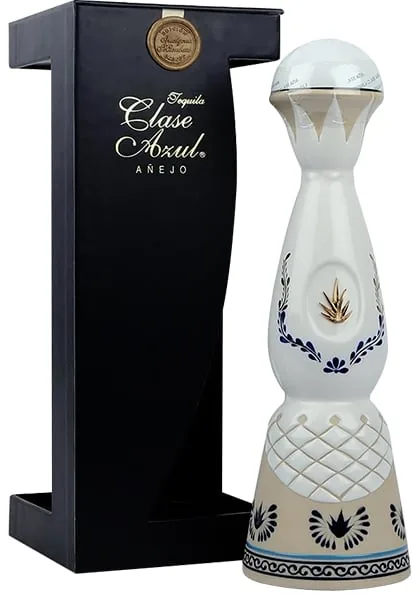
Los Altos red volcanic highland agave, 72-hr brick-oven cook, oak-aged — Clase Azul Añejo built on deliberate sweetness over agave austerity.
When Arturo Lomelí launched Clase Azul in 1997 at $100 a bottle — into a market where the average tequila sold for $18 — he was not just pricing differently; he was declaring that tequila could occupy the same cultural space as aged Cognac or single malt Scotch, a conviction that predated the luxury agave boom by over a decade.
The agave source is Los Altos de Jalisco, the Jalisco Highlands near Jesús María and Arandas, where red volcanic, mineral-rich soils at high altitude and a cool diurnal climate push Tequilana Weber Blue Agave to grow larger and accumulate more natural sugars than their Lowland counterparts — the physiological foundation of Clase Azul's characteristically full, sweet profile.
Production begins with 100% organic Blue Weber agave harvested at 6–9+ years maturity, whose piñas are slow-cooked in traditional masonry brick ovens for a minimum of 72 hours before milling and fermentation with a proprietary yeast strain. The Añejo then undergoes extended oak aging — barrel specifics undisclosed by the brand — before triple filtration at 40% ABV.
That triple filtration is the deliberate transgression: where peers such as Fortaleza or G4 preserve raw agave character, Clase Azul systematically strips it in favour of a low-burn, dessert-weight smoothness that critics contest and collectors covet.
The hand-painted ceramic decanter, produced by Mazahua artisans over roughly two weeks each, is itself a collectible art object — the vessel inseparable from the liquid's positioning.
ตัวเลือกของซอมเมอลิเยร์: Churros with dark chocolate dipping sauce · Aged manchego with quince paste · Slow-braised short rib with ancho chile glaze
กำลังโหลดบันทึก…
เคยชิมขวดนี้ไหม?
สอบถามเราทาง LINE
สอบถามเกี่ยวกับขวดนี้