 Log in to view
฿฿฿
Wine Enthusiast Wine Vintage Chart 2026 Edition rates Champagne 2008.
A vintage grade rates the growing season in this wine’s region — not this specific bottle. Source.
Product information compiled from producer, importer and reference sources.
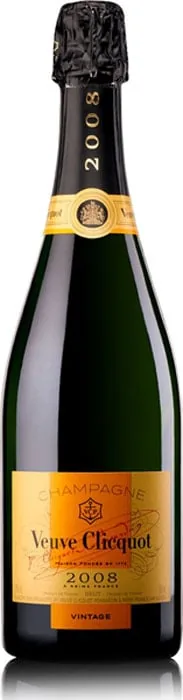
2008 Vintage Brut from Reims' chalk crayères: Pinot Noir-dominant, 5–10 yrs on lees, high-tensile acidity built for decades.
In 1810, Barbe-Nicole Clicquot Ponsardin bottled the first recorded single-vintage Champagne — a declaration that exceptional years deserved to stand alone. The 2008 Vintage Brut inherits that founding logic directly: a cool, high-acid growing season that demanded patience rather than early release.
Fruit originates from Veuve Clicquot's 393-hectare estate spanning 12 Grand Cru villages — Bouzy, Ambonnay, Verzy, Verzenay, Aÿ among them — planted on shallow chalk (craie) hillside soils that drain aggressively, concentrate sugars slowly, and imprint a chalky mineral tension that warmer clay-dominant sites cannot replicate.
Alcoholic fermentation in stainless steel over 8–10 days is followed by full malolactic conversion, softening the vintage's structural acidity without erasing it; since 2008, a proportion of base wines also pass through large oak foudres, adding textural breadth without oak flavour.
The wine then ages a minimum of 5–10 years on lees in bottle inside 24 km of UNESCO-listed chalk crayères beneath Reims, where stable temperature and humidity drive slow autolytic development. What distinguishes 2008 within the Veuve Clicquot range is the
vintage's documented scoring of 95–98 pts across major critics, with assessors noting it remained primary and youthful as late as 2021–2022 — a Champagne whose drinking window extends decades, not years.
Sommelier’s pick: Grilled langoustine with brown butter and tarragon · Aged Comté with honeycomb and walnut bread · Seared scallop with cauliflower purée and caviar
Loading notes…
Tasted this?
Ask us on LINE.
Ask about this item