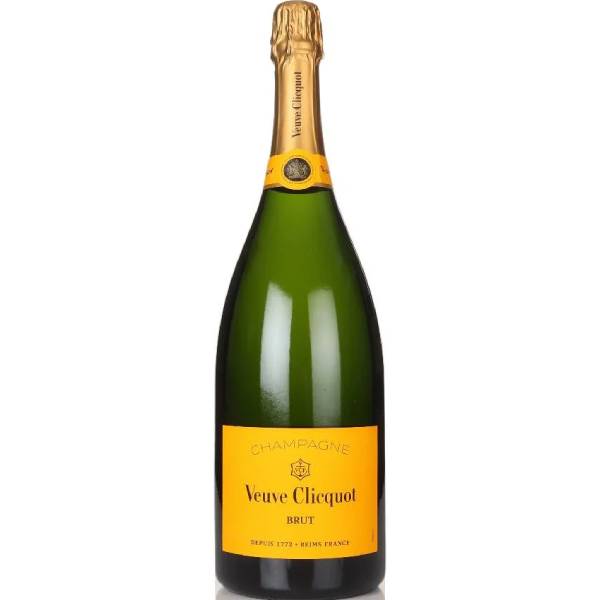
Brut Yellow Label (750 ml)
฿฿
From our sommelier team
The house's flagship non-vintage Brut, its trademark yellow label named for the widow who built the maison — full-bodied, toasty, consistent.
Yellow Label is Veuve Clicquot's flagship non-vintage Brut, a blend of 50-60 different crus built around Pinot Noir (50-55%), with Chardonnay (28-33%) and Meunier (15-20%) filling out the blend, plus a substantial share of reserve wines for consistency year to year. The distinctive yellow label was introduced in 1876 to distinguish the house's dry style from sweeter champagnes then favored on the British market. Expect fresh, yeasty aromatics with green apple and brioche, a balanced palate of ripe fruit, nuts and honeyed orange blossom, and a biscuity finish -- a fuller-bodied, more toasted style than delicate blanc-de-blancs champagnes.
Producer history
The house was founded in 1772 by Philippe Clicquot; its defining figure is Barbe-Nicole Ponsardin, who married his son Francois in 1798. When Francois died in 1805, Barbe-Nicole took over the business herself rather than liquidating it, becoming one of France's first businesswomen -- hence 'Veuve' (widow) in the house name. She built the brand into an international power, including smuggling shipments into Russia during the Napoleonic Wars, and registered the 'Veuve Clicquot Ponsardin' Yellow Label trademark in 1877.
Signature pairings
- Fried chicken or tempura — High acidity and fine bubbles cut through fried batter and oil, a classic champagne-with-fried-food pairing.
- Soft-ripened cheese (Brie or Camembert) — The wine's fuller body and toasty richness stand up to creamy, soft-ripened cheese better than lighter champagnes.
- Pad thai (light on chili, tamarind-forward) (ผัดไทย) — Sweet-sour tamarind and high acidity in the dish mirror the wine's own bright acid, but heavy chili or fish sauce funk risks clashing with its delicate fruit.
In 1816, a 27-year-old widow named Barbe-Nicole Clicquot Ponsardin drilled holes into a kitchen table and invented the riddling pupitre — the mechanical clarification technique that made modern Champagne production possible at scale. That same problem-solving instinct defines Yellow Label today: rather than chasing delicacy, Cellar Master Didier Mariotti assembles 700–800 individual base wine samples from 50–60 crus, blending 25–50% reserve wines held up to 30 years to lock in house consistency across every disgorgement.
The fruit draws from 12 Grand Cru villages — Bouzy, Ambonnay, Verzy, Verzenay, Avize, Le Mesnil-sur-Oger among them — grown on shallow chalk (craie) hillside soils that force deep root penetration and deliver the structural tension that anchors the blend's generous fruit. Alcoholic fermentation runs 8–10 days in stainless steel; full malolactic fermentation is carried out across the range; since 2008, a proportion of base wines pass through large oak foudres for textural complexity. The wine then ages a minimum of 30 months on lees — double the AOC floor — in 24 km of UNESCO-listed chalk crayères beneath Reims.
The blend runs ~50–55% Pinot Noir, 28–33% Chardonnay, 15–20% Meunier, dosage set at 9 g/L. What's unusual: at this price tier, no non-vintage Champagne draws from a comparable breadth of Grand Cru and Premier Cru sources while maintaining this lees-aging commitment. Toasted brioche, chalk-dusted red apple, and white stone fruit resolve into a long, saline finish driven by the craie subsoil signature.
Details
- Country
- France
- Region
- Champagne
- Variety
- Pinot Noir, Meunier, Chardonnay
- Vintage
- N/V
- Bottle size
- 750 ml
Taste profile
- Body
- Medium-Full
- Acidity
- Medium-High
- Sweetness
- Dry
Pairs well with
- Shellfish & crustaceans
- Roast poultry & chicken
- Hard & aged cheese
- Caviar & luxury seafood
- Creamy pasta & risotto
Sommelier’s pick: Grilled langoustine with beurre blanc · Roast chicken with tarragon cream sauce · Seared scallops with cauliflower purée
Interested? Talk to us
Message us to check item availability and information.
Community rating
Loading reviews…