 Log in to view
฿฿฿฿
Grand Cru.
Wine Enthusiast Wine Vintage Chart 2026 Edition rates Champagne 2009.
A vintage grade rates the growing season in this wine’s region — not this specific bottle. Source.
Researched by our team from producer and independent sources — not supplied by the seller.
Agrapart & Fils was founded in Avize, in the Côte des Blancs, by Arthur Agrapart in 1894. His grandson Pierre expanded production through the 1950s and 1960s. Pascal Agrapart has led the family business since 1984, and under him the estate built its reputation
as a terroir-driven grower-producer working its own grand cru parcels — about 12 hectares in 62 plots across Avize, Cramant, Oiry and Oger — rather than buying in fruit.
Production stays small, under 5,400 cases a year, and the range centres on three vintage cuvées: Minéral, L'Avizoise and Vénus. Ambroise Agrapart, the fifth generation, joined his father in 2018. Agrapart & Fils has been awarded three stars in La Revue du vin
de France's Le guide des meilleurs vins de France, one of only nine Champagne estates to hold that rating alongside houses including Selosse, Egly-Ouriet and Krug.
Turbot roasted on the bone with beurre blanc
A zero-dosage Blanc de Blancs raised in oak casks has the acidity to cut a butter sauce and enough texture to stand beside a meaty white fish, which a lighter, dosed Champagne would not.
Steamed river prawns with lime, chilli and garlic dipping sauce (กุ้งแม่น้ำนึ่งน้ำจิ้มซีฟู้ด)
Sweet steamed prawn flesh suits Chardonnay's chalk-grown drive, and the lime-and-garlic sauce matches the wine's bone-dry finish instead of fighting it. Bubbles and high acidity reset the palate against the chilli; keep the heat moderate, because with no dosage there is no sugar to blunt capsaicin.
Aged Comté or Beaufort with walnuts
Mountain cow's-milk cheeses share the nutty, brothy register that long lees ageing gives this wine, and the acidity and fine bubble scrub away the fat better than a red would at the cheese course.
Product information compiled from producer, importer and reference sources.
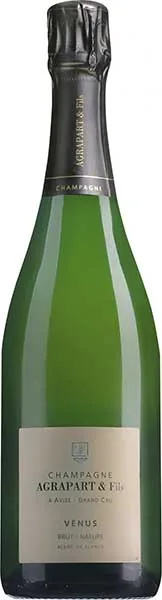
Zero-dosage Blanc de Blancs from La Fosse aux Pourceaux, Avize — 1959-planted vines, old demi-muid oak, second fermentation under cork.
Vénus is Agrapart's most uncompromising statement: zero dosage (Brut Nature), sourced exclusively from La Fosse aux Pourceaux, a single parcel of 0.3–0.6 hectares in Avize planted in 1959 on mixed chalk-and-clay soils — the geological middle ground between the pure belemnite chalk of Minéral and the heavier clay-over-limestone of Avizoise, just metres apart on the same east-facing Côte des Blancs slope.
That chalk-clay mix delivers both the saline tension of the Côte's bedrock and a textural density that makes zero dosage viable where pure-chalk parcels would feel austere. 100% Chardonnay, hand-harvested and vinified parcel-by-parcel in old 600 L demi-muids with indigenous yeasts; full malolactic fermentation; no new oak at any stage.
Crucially, Vénus undergoes second fermentation under cork (agrafé) rather than crown cap — a deliberate choice that introduces micro-oxidation during the secondary fermentation itself, adding complexity unavailable to most Champagnes. Unfined and unfiltered,
with a minimum of 4+ years on lees in chalk cellars at constant 10 °C. The 2009 vintage — a warm, generous year in Champagne — brings ripe stone-fruit density to the cuvée's structural frame, softening the zero-dosage austerity while the old-vine concentration sustains the finish.
Drink 2024–2038.
Sommelier’s pick: Grilled langoustine with brown butter and sea herbs · Aged Comté with walnut bread · Seared scallop with cauliflower purée and caviar
Loading notes…
Tasted this?
Ask us on LINE.
Ask about this item