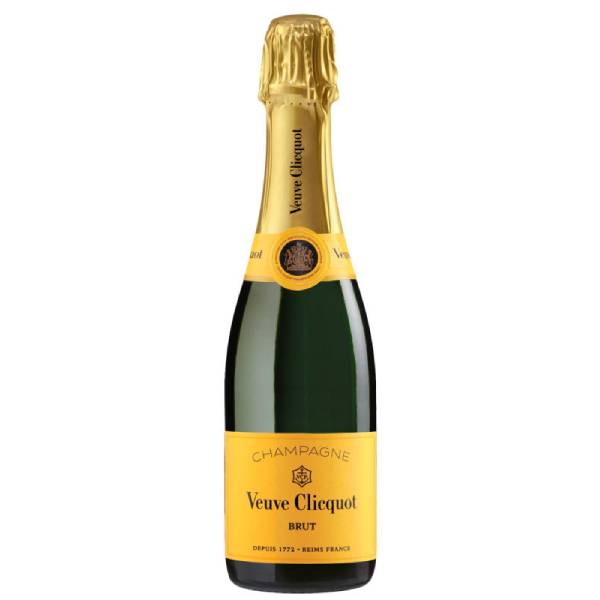
Brut Yellow Label (375 ml)
฿฿
From our sommelier team
The house's flagship non-vintage Brut, its trademark yellow label named for the widow who built the maison — full-bodied, toasty, consistent.
Yellow Label is Veuve Clicquot's flagship non-vintage Brut, a blend of 50-60 different crus built around Pinot Noir (50-55%), with Chardonnay (28-33%) and Meunier (15-20%) filling out the blend, plus a substantial share of reserve wines for consistency year to year. The distinctive yellow label was introduced in 1876 to distinguish the house's dry style from sweeter champagnes then favored on the British market. Expect fresh, yeasty aromatics with green apple and brioche, a balanced palate of ripe fruit, nuts and honeyed orange blossom, and a biscuity finish -- a fuller-bodied, more toasted style than delicate blanc-de-blancs champagnes.
Producer history
The house was founded in 1772 by Philippe Clicquot; its defining figure is Barbe-Nicole Ponsardin, who married his son Francois in 1798. When Francois died in 1805, Barbe-Nicole took over the business herself rather than liquidating it, becoming one of France's first businesswomen -- hence 'Veuve' (widow) in the house name. She built the brand into an international power, including smuggling shipments into Russia during the Napoleonic Wars, and registered the 'Veuve Clicquot Ponsardin' Yellow Label trademark in 1877.
Signature pairings
- Fried chicken or tempura — High acidity and fine bubbles cut through fried batter and oil, a classic champagne-with-fried-food pairing.
- Soft-ripened cheese (Brie or Camembert) — The wine's fuller body and toasty richness stand up to creamy, soft-ripened cheese better than lighter champagnes.
- Pad thai (light on chili, tamarind-forward) (ผัดไทย) — Sweet-sour tamarind and high acidity in the dish mirror the wine's own bright acid, but heavy chili or fish sauce funk risks clashing with its delicate fruit.
In 1816, a 27-year-old widow named Barbe-Nicole Clicquot Ponsardin drilled holes into a kitchen table and invented the pupitre — the riddling board that made mass-produced, clear Champagne possible. That same drive toward structural precision defines the Yellow Label today. Sourced from 50–60 crus across 12 Grand Cru villages — Bouzy, Ambonnay, Verzenay, Aÿ among them — grown on shallow chalk (craie) hillside soils that force vine roots deep, delivering natural drainage, high sun exposure, and the taut mineral backbone that anchors the house's generous fruit. The blend runs Pinot Noir-dominant (~50–55%), with Chardonnay (28–33%) and Pinot Meunier (15–20%); 25–50% reserve wines spanning up to 30 vintages are folded in for consistency and depth. Alcoholic fermentation in stainless steel is followed by full malolactic conversion, softening the chalk-driven acidity into a rounder texture, while a small proportion of base wines see large oak foudres (a practice introduced in 2008) for added complexity. The wine ages a minimum of 30 months on lees — double the AOC requirement — in 24 km of UNESCO-listed chalk crayères beneath Reims, before disgorgement at 9 g/L dosage. What sets this half-bottle apart is unchanged: the same assemblage philosophy as the full format, compressed into a format that accelerates development slightly, making it the most immediately expressive entry point into the house's Pinot-led architecture.
Details
- Country
- France
- Region
- Champagne
- Variety
- Pinot Noir, Meunier, Chardonnay
- Vintage
- N/V
- Bottle size
- 375 ml
Taste profile
- Body
- Medium-Full
- Acidity
- Medium-High
- Sweetness
- Dry
Pairs well with
- Shellfish & crustaceans
- Roast poultry & chicken
- Hard & aged cheese
- Caviar & luxury seafood
Sommelier’s pick: Grilled langoustine with brown butter and tarragon · Aged Comté with honeycomb · Tempura prawn with yuzu kosho aioli
Interested? Talk to us
Message us to check item availability and information.
Community rating
Loading reviews…