 Log in to view
฿฿฿
Product information compiled from producer, importer and reference sources.
Cave Spring Hollow limestone water + 10-ft sugar maple charcoal mellowing before barrel — the step that legally separates Tennessee Whiskey from bourbon.
The technique at the core of this whiskey was first practiced by Nathan 'Nearest' Green, an enslaved man who served as the distillery's original Master Distiller — a contribution formally erased from official histories until the 2010s. That method, the Lincoln
County Process, remains the defining act: new-make spirit distilled to 140 proof in a 100-foot copper column still is gravity-fed drop-by-drop through 10-foot vats of handmade sugar maple charcoal over 3–5 days before any barrel contact, stripping harsh congeners in a way no bourbon undergoes.
The distillery occupies Cave Spring Hollow, Lynchburg, Moore County, where a limestone cave spring delivers iron-free water at a constant 56°F (13°C) year-round — iron being actively detrimental to whiskey flavor. Multi-storey rickhouses expose barrels to Tennessee's full seasonal temperature swings, driving wood interaction across a typical 4–8 year aging cycle in 100% new charred American white oak.
Old No. 7 is a mingle of 175–200 barrels per batch, drawing from multiple rickhouse floors to balance upper-floor wood intensity against slower lower-floor development. The 80% corn / 12% malted barley / 8% rye mash bill is fermented in open-top cypress vats using a sour mash process with up to 30% backset, then bottled at 40% ABV after chill filtration.
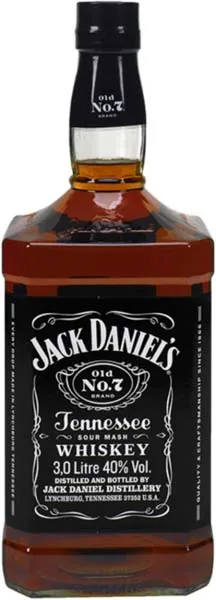
This 3-litre format delivers the identical liquid at scale — no formula change, no age-statement compromise. Moore County, where this whiskey is made, remains legally dry: it cannot be purchased locally.
Sommelier’s pick: Slow-smoked St. Louis-cut pork ribs with brown sugar dry rub · Pecan-crusted chicken with bourbon-honey glaze · Dark chocolate brownie with salted caramel
Loading notes…
Tasted this?
Ask us on LINE.
Ask about this item