 Log in to view
฿฿
Product information compiled from producer, importer and reference sources.
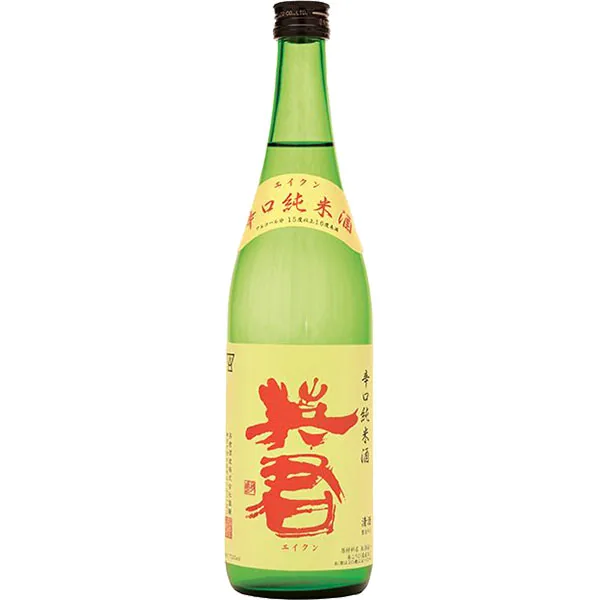
Fushimi kura, Fusui soft-spring water, Iwai rice polished to 60% — Eikun's entry-level Junmai delivers the house's signature onna-zake texture at table-ready dryness.
When the Saito family formally adopted the name Eikun in 1915 — marking Emperor Taisho's ascension — they were already two decades into building a reputation around a single conviction: that Fushimi's underground water, not winemaking intervention, should define the sake.
That water, the Fusui spring flowing beneath the Momoyama Hills, is low-iron, low-mineral, and very soft — designated among Japan's top 100 water sources by the Ministry of the Environment — and it is the structural reason Fushimi sake pours with a rounded, almost silken weight that the harder, sulfate-rich wells of Nada cannot replicate.
This Karakuchi Junmai is built on Iwai rice, polished to a seimaibuai of approximately 60%, sourced almost entirely from Kyoto Prefecture — a variety Eikun controls at roughly 40% of total annual production, making it effectively unavailable to breweries outside the region.
Fermentation follows sandan jikomi (three-addition) cold-temperature protocol under Kyoto-sourced yeast, guided by a toji of the Nanbu Toji guild, with standard hiire pasteurisation before bottling at approximately 15–16% ABV.
The transgression here is the SMV positioning: labelled karakuchi (dry), yet the Fusui water's softness prevents the sharp, austere finish that dry sake from harder-water regions delivers — the dryness reads clean and grain-forward rather than austere. Drink now through near-term; serve lightly chilled at 10–12°C or warmed to 45°C to open the rice umami.
Sommelier’s pick: Grilled white-flesh fish with yuzu kosho · Kyoto-style simmered tofu (yudofu) with dashi · Chilled soba with tsuyu and grated daikon
Loading notes…
Tasted this?
Ask us on LINE.
Ask about this item