 Log in to view
฿฿฿
Product information compiled from producer, importer and reference sources.
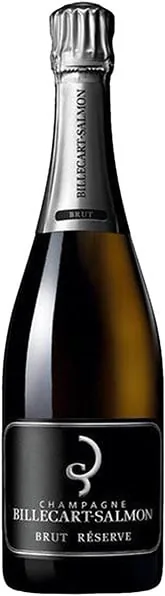
Chalk-cellar NV averaging ~50 months on lees; double cold-settling at 13°C sets Billecart-Salmon's Brut Réserve apart from every peer in Champagne.
In 1958, Jean Roland-Billecart borrowed a technique from the brewing industry — double cold-settling of must followed by fermentation held at ~13°C for 3–4 weeks rather than the industry norm of 2–3 days — and in doing so permanently separated Billecart-Salmon's aromatic register from the rest of Champagne.
That decision is the direct ancestor of every bottle of Brut Réserve poured today.
Grapes are drawn from ~300 hectares across 40 crus within 20 km of Épernay: Pinot Meunier from the Vallée de la Marne's chalk-over-clay soils, Chardonnay from the pure chalk Grand Crus of the Côte des Blancs, and Pinot Noir from the Montagne de Reims. The
chalk subsoil governs everything — slow water release through dry summers, natural temperature regulation, and a mineral tension that no clay-dominant site replicates.
The blend runs ~40% Pinot Meunier, ~30% Chardonnay, ~30% Pinot Noir, vinified parcel-by-parcel in 150 individual 40-hl thermoregulated stainless-steel tanks. Over 50% reserve wines from up to 15 back-vintages are incorporated, and the current release averages ~50 months on lees in 17th-century chalk tunnels — far beyond the 15-month NV legal minimum.
Dosage is 3 g/L Extra Brut, disclosed per bottle via the MyOrigin QR code alongside disgorgement date and varietal composition.
The Meunier-dominant architecture is the transgression: where most grandes maisons minimize Meunier's role, Billecart makes it the structural spine, delivering a roundness that the extended lees aging then lifts into precision rather than weight.
Sommelier’s pick: Steamed sea bass with ginger and spring onion · Grilled langoustines with tarragon butter · Burrata with white truffle and sea salt
Loading notes…
Tasted this?
Ask us on LINE.
Ask about this item