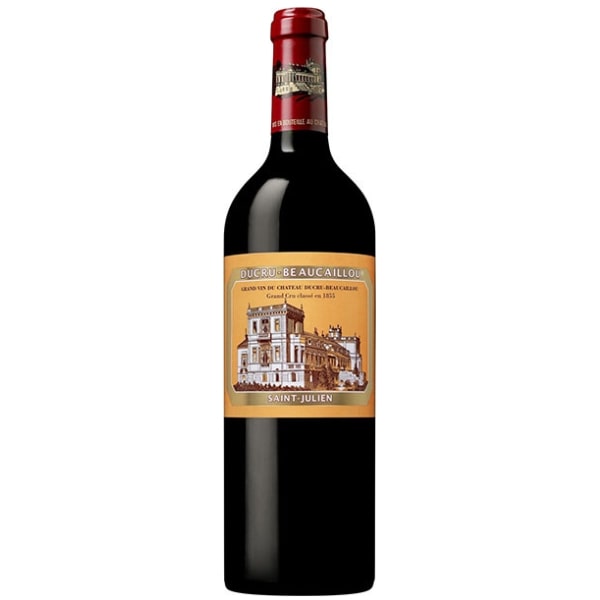
2017
฿฿฿฿
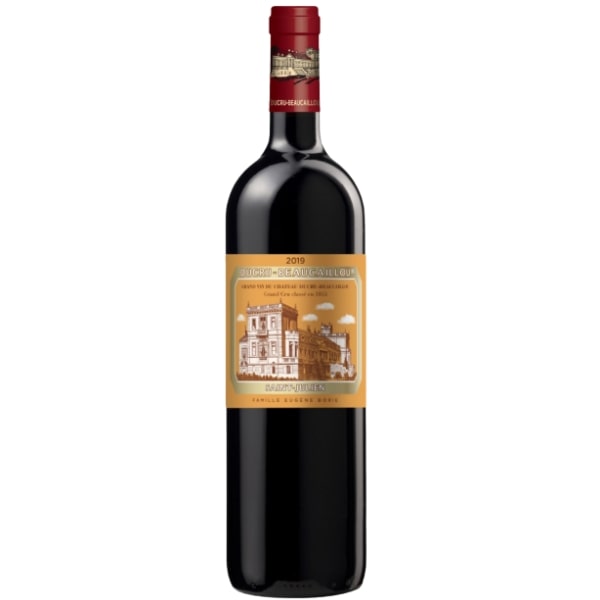
Chateau Ducru Beaucaillou: curated benchmark producer.
From our sommelier team
A Saint-Julien second growth defined by Cabernet Sauvignon-led structure, precision, and a restrained, mineral style rather than raw power — long considered a benchmark 'Super Second.'
Château Ducru-Beaucaillou is a Saint-Julien estate classified as a Deuxième Cru (Second Growth) in the 1855 classification and is widely regarded within the trade as a 'Super Second' — a wine that performs at a level above its official rank. The vineyard's base planting runs roughly 70% Cabernet Sauvignon and 30% Merlot, though the Grand Vin's actual blend in a given vintage skews even more toward Cabernet Sauvignon (commonly 85-90%) after strict selection sends declassified lots to the estate's second wine. This heavy Cabernet Sauvignon weighting is the source of the house style: firm, fine-grained tannin, pronounced graphite and crushed-rock minerality, and a cool, precise aromatic profile (blackcurrant, violet, cedar) rather than the riper, rounder register of more Merlot-driven Saint-Juliens. Winemaking is meticulous and plot-by-plot, with aging in a high proportion of new French oak. The wines are built for extended cellaring and are known among Bordeaux specialists for tightening into a leaner, more mineral, more precisely delineated style in the modern era as selection criteria for the Grand Vin have become stricter.
Producer history
The estate's site has documented history stretching back to the 13th century, though its modern identity was shaped much later. The Johnston family, Bordeaux négociants, held the property before the 1929 financial crisis forced its sale to the Desbarat family. Ownership changed again amid the instability of the following decade, and in 1941 wine merchant Francis Borie purchased Château Ducru-Beaucaillou, beginning the modern Borie era. Jean-Eugène Borie took over from his father in 1953, followed by François-Xavier Borie from 1978 (formally after his father's death in 1998), and since 2003 the estate has been run by Bruno Borie, the third generation of the family since the 1941 purchase. This near-continuous single-family stewardship across more than eighty years is unusual even by Bordeaux standards and underpins the estate's reputation for consistency.
Signature pairings
- Herb-crusted rack of lamb — Lamb's fat content and savory char match the wine's firm Cabernet tannin, and the herb crust picks up the wine's own cedar and graphite tones without competing with them.
- Grilled venison or wagyu striploin — A precise, mineral, tannic wine like this needs a lean but well-marbled red meat to resolve its tannin structure; venison's slight gaminess also echoes the wine's savory, non-fruit-forward register.
- Aged hard cheese, e.g. Comté 24-month — This is a firm, high-tannin wine that does not pair well with high-chile-heat Thai dishes, where capsaicin would sharpen the tannin into bitterness; a dense, low-acid aged cheese is a safer match than forcing a spicy regional pairing.
In 1878, the estate's manager Ernest David and owner Nathaniel Johnston developed Bordeaux mixture on this very property — the copper-sulfate treatment that saved global viticulture from mildew. That instinct to act against convention persists: under Bruno Borie, who took the helm in 2003, Grand Vin production was cut from over 20,000 to just 6,000–8,000 cases annually, with only 27% of vineyard output selected for the label — a selectivity rate rare even among classified growths.
The core 50-hectare block surrounding the château sits on a 6–8 metre bed of Günz gravel — quartz pebbles, lydian jasper, flint, and agatoids deposited by the ancient Garonne roughly two million years ago over Oligocene mud and Eocene limestone. The Gironde estuary's four daily tidal movements moderate summer heat and deflect hailstorms, preserving the linear, graphite-driven tension that defines Saint-Julien's southern end.
Harvest is fully manual with multiple sorting passes including optical sorting. Vinification proceeds parcel-by-parcel in variably sized stainless steel tanks, with maceration of approximately seven days and gentle extraction at moderate temperatures. Malolactic fermentation is completed in concrete and stainless vats before 18–20 months in 100% new French oak barriques from five selected cooperages — a counter-cultural choice at this level, bucking the Médoc trend toward reduced new oak.
The 2017 vintage, not documented in the château's own vintage notes, falls between the monumental 2016 and the torrid 2018, generally producing wines of freshness and mid-weight precision on the Left Bank. Drinking window: approachable from 2024, with genuine upside through 2040+.
Details
- Country
- France
- Region
- Bordeaux
- Subregion
- Saint-Julien
- Variety
- Cabernet Sauvignon, Merlot
- Vintage
- 2017
- Bottle size
- 750 ml
Taste profile
- Body
- Medium-Full
- Acidity
- Medium
- Tannin
- Medium-High
Pairs well with
- Lamb dishes
- Duck & game birds
- Hard & aged cheese
- Cured meats & charcuterie
Sommelier’s pick: Rack of lamb with rosemary and black olive jus · Roasted pigeon breast with lentils du Puy · Aged Comté with walnut bread
Interested? Talk to us
Message us to check item availability and information.
Community rating
Loading reviews…