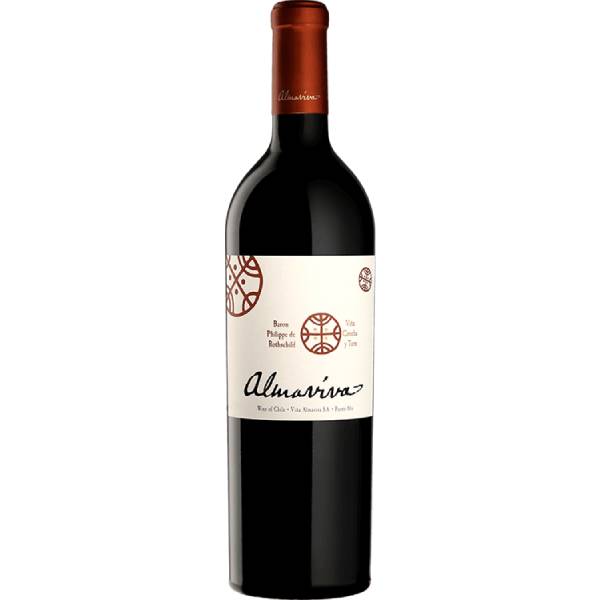
2021
฿฿฿฿
SaleAlmaviva: curated benchmark producer — Chile — Concha y Toro/Mouton Rothschild joint venture.
From our sommelier team
A Cabernet Sauvignon-dominant Bordeaux-style blend (typically 65-80% Cabernet Sauvignon with Carménère, Cabernet Franc, and Petit Verdot) from a single Puente Alto estate at the foot of the Andes, aged 18-20 months in French oak.
Almaviva is produced from a dedicated 65-hectare estate in Puente Alto, on the northern bank of the Maipo River at roughly 650 metres elevation at the foot of the Andes, with an additional smaller parcel of Carménère sourced from Peumo in the Cachapoal Valley. The wine is a Bordeaux-style blend built around Cabernet Sauvignon (typically 65-80%), with Carménère, Cabernet Franc, and — since 2010 — Petit Verdot rounding out the composition; it is aged around 18 to 20 months in French oak. Winemaker Michel Friou, a Frenchman, oversees production, reflecting the estate's Bordeaux-Chile hybrid identity. Puente Alto's stony, well-drained alluvial soils and cooling Andean influence give Almaviva a firmer, more structured character than warmer-zone Chilean Cabernet, with the Carménère component contributing the spice and dark-fruit signature distinctive to Chilean blends of this style. Since its 1998 commercial launch, it was the first non-Bordeaux wine ever offered through Bordeaux's La Place négociant network, a marker of how the project was positioned from the outset.
Producer history
Almaviva was founded as a 50/50 joint venture between Baron Philippe de Rothschild SA (owner of Château Mouton Rothschild in Pauillac) and Viña Concha y Toro, one of Chile's largest and most established wine companies. The partnership was formalized in 1997, though the inaugural 1996 vintage was harvested before the agreement was formally signed; the wine launched commercially in 1998. The explicit goal behind the venture was to create a Chilean wine of Bordeaux Grand Cru Classé caliber and ambition, pairing Bordeaux winemaking pedigree with a single dedicated Maipo Valley estate rather than treating it as a side project of either parent company. That structure — one estate, one wine, a shared French-Chilean winemaking team — has remained consistent since founding.
Signature pairings
- Grilled ribeye steak — Cabernet Sauvignon-dominant structure and firm tannins are built for the char and fat of a well-marbled grilled steak, a natural regional pairing.
- Lamb empanadas — The Carménère component's spice notes echo the cumin and spice typical of Chilean lamb empanada filling, while the wine's tannin stands up to the pastry richness.
- Thai beef panang curry (แกงพะแนงเนื้อ) — Panang's thick, nutty, coconut-and-peanut sauce and moderate (not sharp) chili heat give the wine's firm tannins something rich and fatty to soften against, unlike clear-broth or very spicy Thai preparations that would clash.
When Baroness Philippine de Rothschild and Eduardo Guilisasti Tagle formalized their joint venture in 1997, they imposed a single constraint that shaped everything: one terroir, one bodega, one team, one wine — the French Château concept transplanted to the foot of the Andes. That discipline is why only ~50% of estate fruit ever reaches this label. The Puente Alto site sits at 620–650 m elevation on classic Andean alluvial fan deposits — loamy clay to 50 cm, then sandy loam, gravel, and rock — soils so poor and free-draining that vines, some ungrafted and planted as early as 1978, are forced deep for water, concentrating extract while the Andes' diurnal swings preserve acidity at 15% ABV. Hand-harvested fruit is cold-macerated in parcel-specific stainless steel tanks, then fermented and transferred entirely by gravity — no pumps — before spontaneous malolactic fermentation occurs directly in French oak barrels (70–73% new, 20 months), integrating wood from the first contact with the finished wine. The 2021 blend — 71% Cabernet Sauvignon, 22% Carmenère, 5% Cabernet Franc, 2% Petit Verdot — runs cooler and more restrained than the preceding drought vintage, with the Carmenère's roasted-pepper and dark-spice register woven tightly into the structure rather than forward on the nose. No Bordeaux or Napa peer can legally include Carmenère; that variety, lost to phylloxera in France and rediscovered in Chile, is the flavor signature no other first-growth-tier wine can replicate. Drink 2026–2046.
Details
- Country
- Chile
- Region
- Central Valley
- Subregion
- Maipo Valley
- Variety
- Cabernet Sauvignon, Carmenère, Cabernet Franc, Petit Verdot
- Vintage
- 2021 **
- Bottle size
- 750 ml
** Vintage may change — please confirm with our team before ordering.
Taste profile
- Body
- Full
- Acidity
- Medium
- Tannin
- Medium-High
Pairs well with
- Grilled red meat & steak
- Lamb dishes
- Duck & game birds
- Hard & aged cheese
- Game meats
Sommelier’s pick: Grilled bone-in ribeye with chimichurri · Slow-braised lamb shoulder with black olive and rosemary · Duck confit with lentils and smoked paprika jus
Interested? Talk to us
Message us to check item availability and information.
Community rating
Loading reviews…