 Log in to view
฿฿฿฿
Product information compiled from producer, importer and reference sources.
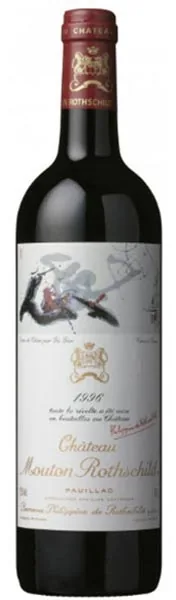
Plateau de Mouton's deep Günzian gravel, 1996's cool precision, 100% new French oak — a Left Bank First Growth at its most architecturally severe.
Baron Philippe de Rothschild's 1924 decision to château-bottle his own wine — then a radical act in a Médoc that sold in bulk — is the founding logic of every bottle that followed: total control from vine to cork. The 1996 vintage arrived at a moment when
Pauillac's cool, late-ripening season stripped away the hedonistic plushness that defines Mouton's signature and replaced it with something rarer: structural austerity and graphite-edged precision.
The Plateau de Mouton sits at roughly 27 m elevation on a gravel croupe whose Günzian gravel descends over 5 m before meeting clay-limestone and iron-rich marl — a drainage profile that, in a cool year, concentrates rather than dilutes, pushing intensity inward rather than outward.
Fermentation in oak vats, parcel by parcel, followed by 19–22 months in 100% new French oak barriques in the Grand Chai — the 100-metre hall built in 1926 — and fining with egg white before bottling. The 1996 blend skews heavily toward Cabernet Sauvignon, consistent with the estate's range of 77–94%, amplifying the vintage's tannic density and cassis-and-cedar architecture.
What distinguishes 1996 within the Mouton canon is precisely what it withholds: the opulence is deferred, replaced by a wine that has aged into a slow, mineral-driven complexity that warmer years cannot replicate. Now approaching its third decade, the 1996 is entering a compelling drinking window for those who value precision over power.
Sommelier’s pick: Roasted rack of lamb with rosemary jus and flageolet beans · Dry-aged côte de bœuf with bone marrow butter · Braised short rib with black truffle and celeriac purée
Loading notes…
Tasted this?
Ask us on LINE.
Ask about this item