 Log in to view
฿฿฿฿
Product information compiled from producer, importer and reference sources.
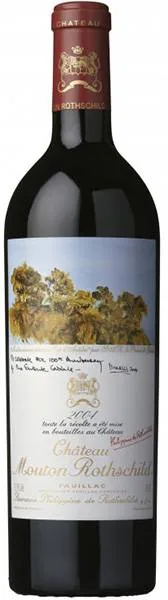
Plateau de Mouton's deep Günzian gravel, 100% new French oak, and a Petit Verdot-free blend define this brooding 2004 Pauillac Premier Cru.
Baron Philippe de Rothschild pioneered château-bottling in 1924 — a practice now universal across Bordeaux — and that same instinct for control over every variable defines how the 2004 was made: hand-harvested, hand-sorted, gravity-fed to oak fermentation vats to eliminate pump stress, then allocated only to the finest parcels, which at Mouton means at most 50% of total estate production reaches the Grand Vin label.
The Plateau de Mouton rises to 27 m above sea level in northern Pauillac, its soils composed of deep Günzian gravel descending over 5 m over iron-rich clay-limestone marl — a profile that drains aggressively, forces vine roots deep, and retains daytime heat into cool Atlantic nights.
The oceanic microclimate, moderated by both the Gironde Estuary and the Atlantic, tempers ripening and preserves acidity.
Vinification proceeded in oak fermentation vats — one of the last Médoc châteaux to retain this practice — followed by malolactic fermentation in tank. The wine then aged 19–22 months in 100% new French oak barrels (medium toast) in the 100-metre Grand Chai before egg-white fining prior to bottling.
The 2004 blend excluded both Petit Verdot and Cabernet Franc, producing a binary Cabernet Sauvignon–Merlot structure that sharpens the graphite and tobacco register characteristic of the plateau's iron-rich subsoil. Now approaching its third decade, the 2004 has resolved much of its early tannic density into a savoury, cedar-framed core with the long finish typical of deep-gravel Pauillac.
Sommelier’s pick: Roasted rack of lamb with rosemary jus · Dry-aged côte de boeuf with bone marrow butter · Braised Ibérico pork cheek with black truffle
Loading notes…
Tasted this?
Ask us on LINE.
Ask about this item