 Log in to view
฿฿฿
Product information compiled from producer, importer and reference sources.
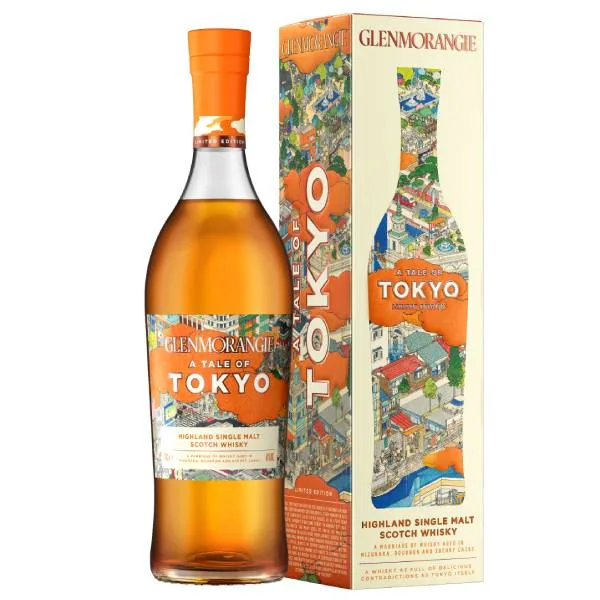
Highland malt finished in Japanese Umeshu casks — Tain's tallest stills meet Tokyo's plum-wine tradition in a limited cross-cultural expression.
Glenmorangie's A Tale of Tokyo emerges from a deliberate cultural transgression: the distillery's Dr. Bill Lumsden chose to finish the whisky in casks that previously held Japanese Umeshu (plum wine), a finishing vessel with no precedent in Highland Scotch production.
That choice is only possible because of Glenmorangie's Extra Maturation philosophy — pioneered commercially in the early 1990s — which treats secondary cask finishing as a compositional tool rather than a corrective measure.
The base spirit originates at Morangie Farm, Tain, Ross-shire, on the southern shore of the Dornoch Firth. Water drawn from Tarlogie Springs filters through limestone and sandstone for up to 100 years, producing unusually hard, mineral-rich water that contrasts sharply with the soft water of most Speyside distilleries.
Double distillation through Scotland's tallest spirit stills at 5.14 m — descended from London gin stills acquired in 1843 — enforces extreme copper reflux, stripping heavy congeners and yielding one of the lightest, most floral new-make spirits in Scotland.
Primary maturation proceeds in ex-bourbon American white oak casks from Glenmorangie's own Ozark Mountain forests, air-dried two years and bourbon-seasoned before first use.
The Umeshu finish then layers stone-fruit intensity — tart plum skin, cherry blossom — over the distillery's signature citrus-and-vanilla framework.
The Umeshu cask finish is the defining anomaly: no other Highland distillery has deployed this vessel commercially, making this expression a genuine category outlier.
Sommelier’s pick: Miso-glazed black cod with pickled daikon · Duck breast with plum and five-spice reduction · Wagyu beef tataki with ponzu and yuzu kosho
Loading notes…
Tasted this?
Ask us on LINE.
Ask about this item