 Log in to view
฿฿฿
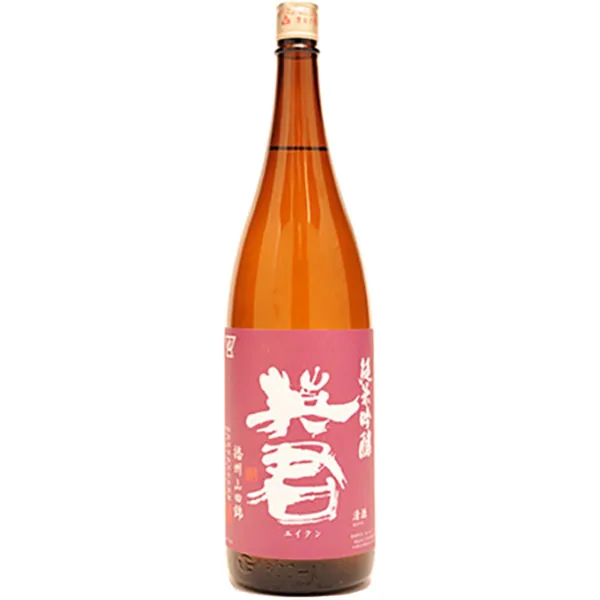
Junmai Ginjo.
Product information compiled from producer, importer and reference sources.
Fushimi soft-water ginjo from the kura controlling ~40% of Kyoto's Iwai rice — a hyper-regional terroir no brewery outside the prefecture can replicate.
When the Saito family adopted the name Eikun in 1915 to mark Emperor Taisho's ascension, they were already shaping what would become the definitive expression of Fushimi onna-zake — sake deliberately calibrated to the soft, low-iron Fusui spring water flowing beneath the Momoyama Hills, designated one of Japan's top 100 water sources.
That mineral-lean water is the structural reason Eikun reads as mellow rather than assertive: low dissolved solids suppress harsh fermentation by-products and allow delicate ginjo aromatics to surface unobstructed.
The rice is Iwai — a Kyoto-exclusive variety developed in 1933, revived in 1988, and sourced almost entirely from Eikun's own contracted farms, which account for roughly 40% of all Iwai grown in the prefecture. Polished to 60% seimaibuai (Junmai Ginjo grade), the grain yields a rounder, slightly fuller texture than Yamada Nishiki at equivalent polish.
Fermentation follows sandan jikomi (three-addition) cold-temperature protocol under Kyoto-sourced yeast, guided by a toji of the Nanbu Toji guild. The sake is pasteurised (hiire) prior to bottling at approximately 15–16% ABV — no added distilled alcohol in any junmai-designated expression.
The 1.8 L isshobin format slows oxidative evolution after opening, making this the most cellar-stable format in the Eikun range. Drink within 6–12 months of purchase; serve at 10–12 °C to preserve the Iwai rice's characteristic gentle sweetness.
Sommelier’s pick: Steamed chawanmushi with lily bulb and ginkgo · Lightly seared hotate (scallop) with yuzu kosho butter · Cold somen noodles with dashi dipping broth
Loading notes…
Tasted this?
Ask us on LINE.
Ask about this item