 Log in to view
฿฿
Product information compiled from producer, importer and reference sources.
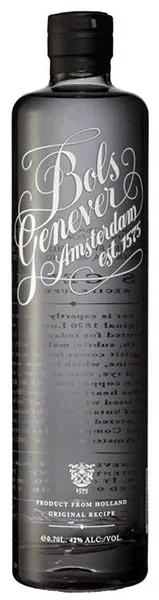
The 1575 Amsterdam original: triple-distilled malt-wine genever that predates London Dry by 150 years, with a grain-forward weight closer to unaged whiskey than any modern gin.
When Jerry Thomas published his 1862 Bartender's Guide, the spirit in the Martinez and Holland House was this — Bols Genever, the dominant base spirit of 19th-century American cocktail culture, distilled at 31 Pijlsteeg, Amsterdam, steps from Dam Square, on a site tracing to 1679.
The house philosophy, Semper Idem (Always the Same), is not a marketing slogan but a production mandate: every batch must match the archive.
The malt-wine backbone is triple-distilled in copper pot stills from a grain mash of malted barley, rye, corn, and wheat, cut deliberately low at approximately 47% ABV to preserve pronounced grain character. That malt wine — comprising over 50% of the final
blend — is then married with neutral grain spirit and a separate botanical distillate (juniper, coriander, caraway, aniseed, plus a proprietary ingredient recovered from 17th-century Bols archives), redistilled in the same copper pots.
The standard expression is bottled at 42% ABV, unaged.
What no peer in the modern gin category replicates: the malt-wine base gives Bols Genever a structural weight — cereal depth, faint wort sweetness — that sits categorically between whiskey and gin, making it a functionally distinct ingredient rather than a stylistic variation. The botanical register is secondary to grain, not the reverse.
Sommelier’s pick: Pickled herring on rye with mustard cream · Aged Gouda with caraway seed crackers · Pork belly with fennel and apple compote
Loading notes…
Tasted this?
Ask us on LINE.
Ask about this item