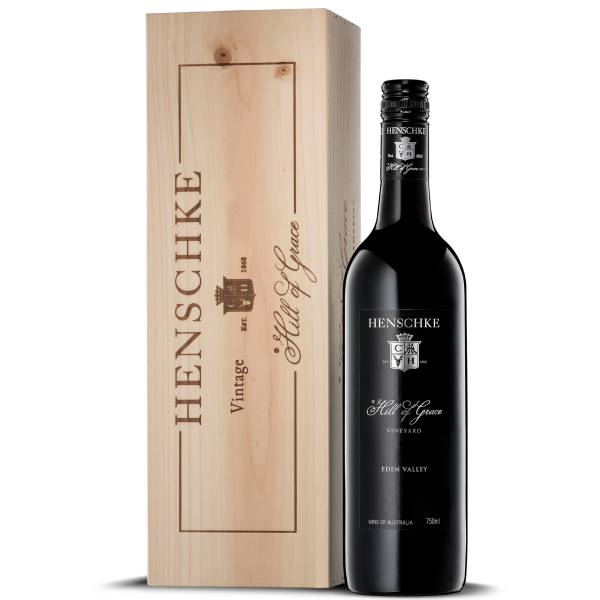
Hill Of Grace Shiraz, Eden Valley
฿฿฿฿
Henschke: curated reference producer — Hill of Grace — one of Australia's most iconic and expensive wines.
From our sommelier team
An icon single-vineyard Shiraz from ungrafted, pre-phylloxera vines dating to the 1860s in South Australia's Eden Valley, made by a fifth-generation family estate and regarded alongside Penfolds Grange as one of Australia's two most celebrated wines.
Hill of Grace is Henschke's flagship single-vineyard Shiraz, sourced from a roughly 4-hectare block in the Eden Valley containing some of the oldest continuously producing Shiraz vines in the world, planted in the 1860s and never affected by phylloxera. Cyril Henschke, the third generation to run the family winery, first released Hill of Grace as a standalone single-vineyard wine in the 1958 vintage, made from hand-picked fruit fermented in traditional open-top fermenters — an approach to old, low-yielding vines that has been refined but not fundamentally changed since. The wine's reputation rests on the combination of extreme vine age, the site's cool-climate elevation within the Mount Lofty Ranges, and a winemaking philosophy under Stephen and Prue Henschke that favors careful, minimal-intervention handling of exceptional fruit over heavy-handed cellar technique. It is consistently discussed alongside Penfolds Grange as one of the two wines most identified internationally with Australian fine wine, valued for combining old-vine concentration with real structure and aging potential rather than sheer power alone.
Producer history
The Henschke family has farmed and made wine at Keyneton in the Eden Valley since 1868, when founder Johann Christian Henschke, an immigrant from Silesia who had arrived in South Australia in 1841, produced the winery's first vintage. The Hill of Grace vineyard itself predates the Henschkes' involvement with it: vines were originally planted there in the early 1860s by another Silesian settler, and the second-generation Paul Gotthard Henschke acquired the land near the Gnadenberg church, which included those vines, around 1891. Third-generation Cyril Alfred Henschke took over in 1950 and, in the following decade, both shifted the winery toward table wines and released Hill of Grace as a distinct bottling for the first time in 1958. Stephen Henschke, the fifth generation of the family to lead the winery, took over with his wife Prue Henschke — the estate's viticulturist — in 1979 after Cyril's death, and the two have run the estate together since, with a sixth generation (Johann, Justine and Andreas Henschke) now also active in the business. The winery remains privately, family-owned — a rarity among wines of Hill of Grace's international standing.
Signature pairings
- Aged Australian lamb loin with native pepperberry — Old-vine Eden Valley Shiraz has enough ripe fruit and structure to match richly flavored lamb, and a regional pairing with Australian native spice reflects the wine's own provenance.
- Char-grilled wagyu with red wine jus — The wine's density and firm tannin frame stand up to the fat content of wagyu, while a red-wine reduction jus bridges the dish and the glass without introducing competing flavors.
- Dark chocolate torte — Concentrated old-vine Shiraz can carry bitter dark chocolate without being flattened by it, a pairing that works on richness-matching rather than sweetness.
When Cyril Henschke bottled the first Hill of Grace in 1958, Australia's fine-wine trade was still dominated by blends and fortifieds — a single-vineyard Shiraz from ungrafted, pre-phylloxera vines was an act of quiet transgression that effectively invented a category. The 'Grandfather' block at the heart of this wine has grown on its original rootstock since approximately 1860, surviving on Parrot Hill, 4 km northwest of Henschke Cellars, under a sharecropping agreement that remains one of Australian viticulture's most unusual arrangements. The 8-hectare site sits at 400 m elevation on alluvial sandy loam grading to deep silty loam with patches of limestone and schist, dry-grown without irrigation; the schist fraction drives the wine's tensile mineral spine while the loam's water-retention moderates the old vines' already minuscule yields. In 2019, record heat of 44.3°C, combined with frost and hail, reduced the crop to 10–15% of a normal harvest — the resulting fruit is concentrated to the point of severity, yet retains the cool-climate Eden Valley precision that separates this address from floor-Barossa Shiraz. Fermentation proceeds in traditional open-top concrete fermenters with full malolactic conversion; no tannin additions are made, and natural grape acidity from the old vines is relied upon structurally. Aging runs 18 months in French and American oak hogsheads, with recent releases weighted approximately 86% French / 14% American, ~33% new oak. What no peer replicates: six discrete blocks spanning plantings from c.1860 through 1965, blended as a single vineyard expression from own-rooted, ungrafted vines that predate phylloxera's arrival in Australia. The 2019 is rated 97+ points (Vintage Journal); drink 2025–2038+.
Details
- Country
- Australia
- Region
- South Australia
- Subregion
- Barossa Valley
- Variety
- Syrah
- Vintage
- 2019
- Bottle size
- 750 ml
Taste profile
- Body
- Full
- Acidity
- Medium-High
- Tannin
- Medium-High
Pairs well with
- Grilled red meat & steak
- Indian & spiced dishes
- Hard & aged cheese
- Game meats
- Duck & game birds
Sommelier’s pick: Slow-roasted Wagyu short rib with black garlic jus · Braised lamb shoulder with preserved lemon and harissa · Char-grilled venison loin with juniper and beetroot reduction
Interested? Talk to us
Message us to check item availability and information.
Community rating
Loading reviews…